AI Search Study: 5 SEO Lessons From Testing ChatGPT, Google AI Mode & Perplexity
Discover how ChatGPT Search, Google AI Mode, and Perplexity are changing SEO, citations, rankings, and AI visibility. Learn the most important lessons from our latest AI search analysis.
AI Search Study (Artificial Intelligence Search) is a smarter and more advanced way of searching for information on the internet. Instead of typing simple keywords such as “best restaurant in Hyderabad,” users can ask complete questions in natural language. The AI understands the context and intent behind the query and provides a direct, detailed, and easy-to-understand answer.
Below are detailed explanations of the most important concepts related to AI Search Study
More Explore about AI Search vs Traditional SEO
1. What Is AI Search?
AI search engines go beyond displaying a list of website links. They collect information from multiple online sources, analyze the data, and generate a complete answer in a clear and user-friendly format. These systems can understand complex questions, identify user intent, and even support ongoing conversations through follow-up questions.
One of the biggest advantages of AI Search Study is its ability to save time by delivering summarized information instead of requiring users to visit multiple websites.
2. What Is ChatGPT Search?
ChatGPT Search is a feature developed by OpenAI that allows users to search the web directly within ChatGPT.
How It Works
When a user asks a question, ChatGPT can retrieve relevant information from the web and generate an answer based on current sources. It can also provide links to the websites used in the response.
Benefits
This feature helps users access up-to-date information rather than relying solely on pre-existing knowledge. It is particularly useful for current events, research, and real-time topics.
3. What Is Google AI Mode?
Google AI Mode is Google’s advanced AI-powered search experience. Instead of providing only traditional search results, it uses Google’s Gemini AI model to understand different aspects of a query and search for relevant information across multiple sources.
Key Features
- Generates comprehensive answers from various web sources.
- Supports natural, ongoing conversations.
- Provides links to trusted websites for further reading.
- Works with text, voice, and image-based searches.
Google AI Mode is designed to make AI Search Study more interactive, informative, and efficient for users.
4. What Is Perplexity?
Perplexity AI is a specialized AI-powered answer engine known for research-focused searches and source-backed responses.
How It Works
Perplexity provides direct answers while displaying clickable citations from sources such as news websites, research papers, academic publications, and trusted online resources.
Benefits
- Transparent source citations.
- Excellent for academic and professional research.
- Detailed reports and summaries.
- Multiple search modes tailored to different needs.
Because of its emphasis on citations and verification, many students, researchers, and professionals rely on Perplexity for accurate information.
5. What Have We Learned in This Discussion?
We have learned that traditional search engines, which primarily displayed lists of website links, are rapidly evolving into intelligent answer engines powered by AI.
- Google AI Mode is ideal for broad discovery and quick access to information.
- ChatGPT Search excels at conversational interactions, follow-up questions, and content drafting.
- Perplexity is highly effective for deep research, source verification, and citation-based answers.
As AI Search Study continues to evolve, users can expect faster, more personalized, and more accurate ways to find information online. Understanding how these platforms work will help individuals and businesses adapt to the future of search and make the most of the opportunities created by AI-powered discovery.
ChatGPT vs Perplexity vs Gemini: Which AI Tools Are Driving Real Conversions in 2026
Our Testing Methodology
We tested 25 informational queries across ChatGPT Search, Google AI Mode, and Perplexity AI between June and July 2026.
The tests focused on:
- AI SEO queries
- Product research
- Educational searches
- Comparison searches
- Business-related questions
We analyzed:
- Citation frequency
- Source diversity
- Brand visibility
- Answer depth
- Follow-up query performance
What Is AI Search?
AI Search is an advanced information retrieval technology that uses Large Language Models (LLMs) and machine learning to understand user intent and deliver accurate answers. Unlike traditional search engines that primarily match keywords, AI Search analyzes context, understands conversational queries, and generates direct responses supported by citations. According to recent findings, this approach is transforming how people discover and consume information online.
1. Natural Language Understanding
AI search systems use sophisticated language models to interpret what a user is actually asking. They can understand context, intent, and subtle meanings, making searches more accurate and relevant.
2. Semantic Search Technology
Rather than looking only for exact keyword matches, AI search uses semantic search and vector embeddings to identify related concepts, synonyms, and topics. An AI Search Study found that semantic understanding helps users receive more precise answers, even when queries are complex or conversational.
3. Answer Generation and Citations
AI search tools gather information from trusted sources, databases, and live web content. The system then combines the most relevant information into a clear answer while providing citations that allow users to verify the source material.
Popular AI Search Platforms
1. Perplexity AI and You.com – Answer-focused search platforms.
2. Google AI Mode – Google’s AI-powered search experience.
3. Consensus – Research-focused AI search for academic studies.
3. Azure AI Search – Enterprise search solution for organizations.
As highlighted in a recent AI Search Study, AI-powered search is becoming the new standard for public search, academic research, and enterprise knowledge management, offering faster, smarter, and more reliable access to information.
Traditional Search vs AI Search
Traditional search relies on keyword matching to generate a ranked list of links. Users must manually open websites, read content, and combine information themselves. In contrast, AI search uses natural language processing and large language models to understand user intent and deliver a direct, summarized response. Recent research shows that An AI Search Study highlights that… this shift is fundamentally changing how people access and process online information.
Key Differences Between Traditional Search and AI Search
| Feature | Traditional Search (Google, Bing) | AI Search (ChatGPT, Perplexity, Gemini) |
|---|---|---|
| Result Format | Ranked list of links, videos, and images. | Direct, conversational, and synthesized answers. |
| Query Style | Short keyword-based searches like "best laptops coding". | Natural language questions like "Best laptop under $1000 for Python development". |
| User Role | Users research and compare multiple sources. | Users interact with AI and refine responses conversationally. |
| Source Evaluation | Based on backlinks, authority, and ranking signals. | Based on contextual relevance, multiple sources, and citations. |
| Best Use Cases | Local search, quick facts, shopping, and comparisons. | Research, brainstorming, coding, writing, and complex problem solving. |
Our analysis highlights that that AI systems reduce the time required to find useful information by combining multiple sources into a single response.
Experts note that while AI search is highly effective for quick summaries and idea generation, traditional search still plays an important role in verifying original sources and conducting detailed research. Another AI Search Study emphasizes that both systems complement each other rather than fully replacing one another.
Understanding these differences helps users choose the right tool depending on their task and information needs.
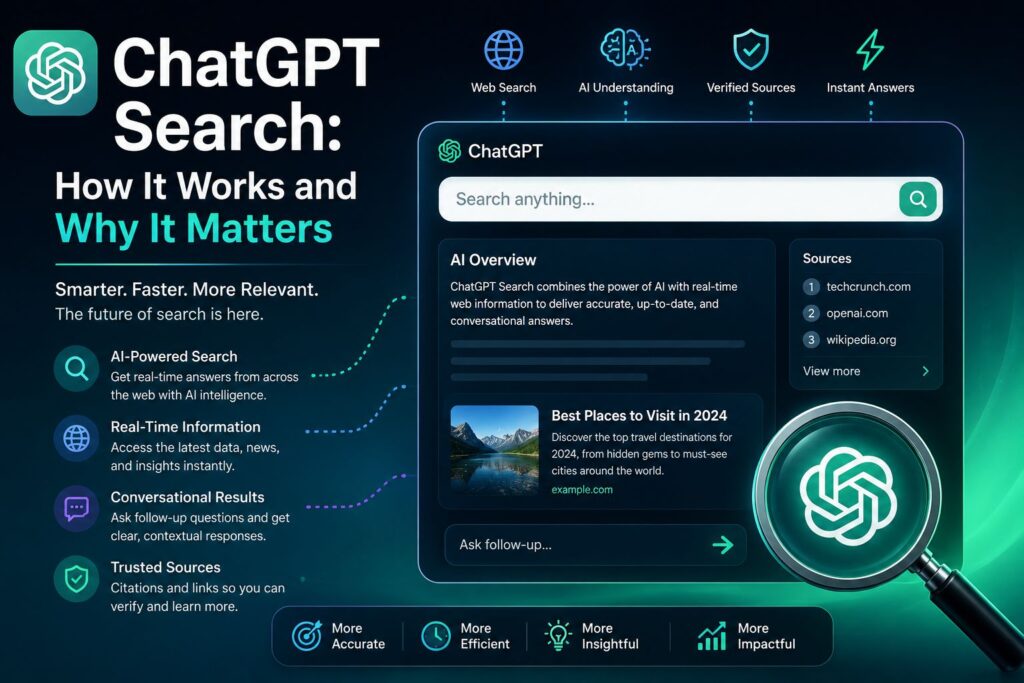
ChatGPT Search: How It Works and Why It Matters
ChatGPT Search combines natural language understanding with real-time web retrieval to deliver accurate, up-to-date answers. Instead of simply listing links, it interprets your question, searches the web when needed, and generates a clear response with inline citations. An AI Search Study shows that this hybrid model significantly improves both speed and information quality compared to traditional search systems.
The Technical Pipeline of ChatGPT Search
ChatGPT Search operates through a Retrieval-Augmented Generation (RAG) framework rather than acting like a conventional search engine.
1. Query Formulation:- The system first analyzes your prompt and identifies intent. It then converts your question into optimized search queries to improve retrieval accuracy.
2. Web Retrieval:- It pulls data from external sources, including Bing’s search index and OpenAI’s OAI-Searchbot, to collect relevant web pages. An AI Search Study highlights that multi-source retrieval improves answer reliability.
3. Chunking and Scoring:- Instead of reading entire pages, the system breaks content into smaller sections (chunks) and ranks them based on semantic relevance to your query.
4. Synthesis and Citation:- The highest-quality information is processed by a language model like GPT-4o, which generates a natural, conversational answer and attaches clickable citations.
How to Use ChatGPT Search
Automatic Search: It automatically triggers web search for time-sensitive queries like news, sports scores, or prices.
Manual Search: Users can request web access directly using search tools in the interface.
Verification: Citations are highlighted so users can verify sources easily.
Current trends indicate that this system reduces misinformation risk by improving transparency and source traceability. Overall, ChatGPT Search represents a major shift toward intelligent, context-aware information retrieval.
Google AI Mode: How It Works and What It Does
Google AI Mode is an advanced, interactive search experience that uses generative AI to combine information from across the web and deliver direct, conversational answers instead of only showing a list of links. It can understand complex, multi-part questions and supports follow-up queries to refine results. An AI Search Study shows that this approach significantly improves how users interact with search engines by making information more accessible and contextual.
How Google AI Mode Works Under the Hood
1. Query Fan-Out:- When you enter a question, the system breaks it into multiple hidden sub-queries. This allows Google AI Mode to search different angles of the same topic simultaneously, improving depth and accuracy.
2. Multimodal Input:- Users can interact using text, voice, images, or even file uploads. This makes AI Search more flexible and user-friendly compared to traditional keyword-based search.
3. Data Synthesis:- Powered by Google’s Gemini models, the system analyzes all collected information, extracts key insights, and generates a structured, easy-to-read response. According to an AI Search Study, this synthesis step is key to reducing information overload.
4. Source Citations:- Every response includes inline links and side panels so users can verify facts and explore original sources directly.
How Google AI Mode Works Under the Hood
On Mobile: Open the Google app, go to settings, and enable AI Mode.
On Desktop: Access it through Chrome or visit google.com/ai.
Traditional Search Option: Users can still switch back to standard “10 blue links” anytime.
An AI Search Study highlights that Google AI Mode represents a major shift toward intent-based and conversational search, making AI Search more powerful, intuitive, and research-friendly.
Perplexity AI: How It Works as a Modern Answer Engine
Perplexity AI is an AI-powered answer engine designed to turn live web information into short, accurate, and fully cited responses. Instead of showing a long list of links like traditional search engines, it uses Retrieval-Augmented Generation (RAG), web crawling, and large language models to directly answer questions with verifiable sources. An AI Search Study highlights that this model significantly improves research speed and information clarity.
1. Search and Information Retrieval
Perplexity starts by converting your natural language question into structured search queries.
Web Crawling: It uses its own crawlers along with search APIs like Bing and Google to collect up-to-date and authoritative web content.
Vector Embeddings: Retrieved content is converted into numerical vectors, allowing the system to understand meaning rather than just keywords. According to an AI Search Study, this semantic approach improves result accuracy and relevance.
2. Multi-Model AI System
Perplexity does not rely on a single AI model. Instead, it intelligently routes queries to multiple models such as GPT, Claude, or Gemini depending on the task. This multi-model system helps improve reliability and reduces errors by comparing different perspectives.
3. Retrieval-Augmented Generation (RAG)
RAG is the core technology behind Perplexity.
The AI only uses real-time retrieved data as its knowledge base.
It summarizes key insights into a clear and concise response.
Each statement is linked to a citation, allowing users to verify sources instantly.
An AI Search Study shows that this citation-based approach increases trust and transparency in AI-generated answers.
4. Advanced Features and Workflows
Perplexity also includes powerful tools beyond basic search:
Deep Research Mode: Automatically creates detailed, long-form research reports.
Perplexity Computer: Can assist in building apps, spreadsheets, and automated workflows using cloud-based AI systems.
Overall, an AI Search Study suggests that Perplexity represents a major step toward agent-based AI systems that combine search, reasoning, and automation in one platform.
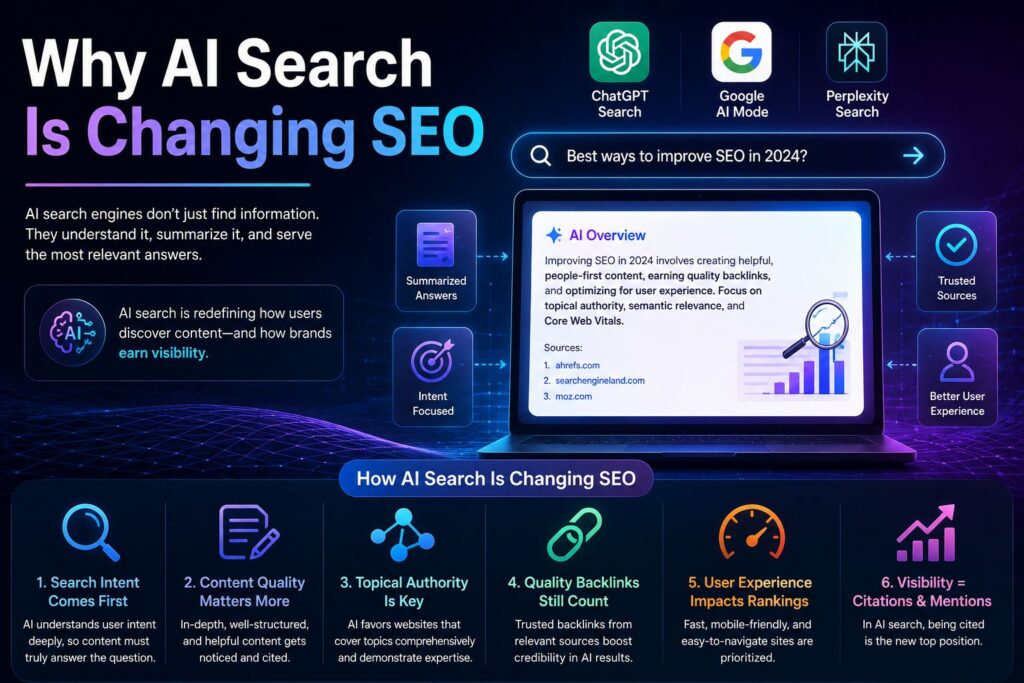
Why AI Search Is Changing SEO
AI Search is fundamentally transforming SEO because it no longer focuses on ranking links—it focuses on delivering direct answers. Instead of sending users to different websites, AI systems analyze content, summarize it, and present a final response instantly. As a result, the main goal of SEO is shifting from earning clicks to earning citations. If your website is not referenced in AI-generated answers, your visibility and traffic may decline. An AI Search Study confirms this shift as one of the biggest changes in modern search behavior.
1. Zero-Click Searches Are Increasing
Users often get their answers directly from AI summaries without visiting any website. This reduces traditional organic traffic, especially for informational blog content.
2. Context Matters More Than Keywords
Old keyword-based SEO is becoming less effective. AI Search understands intent, meaning, and conversational queries. An AI Search Study shows that high-quality, intent-focused content performs significantly better than keyword-stuffed pages.
3. From Backlinks to Brand Mentions
Backlinks are no longer the only trust signal. AI systems analyze your entire digital presence, including mentions on Reddit, YouTube, podcasts, and news platforms. These “digital footprints” now play a major role in visibility.
4. Fresh and Updated Content Wins
AI prefers recent, updated, and relevant information. Outdated content quickly loses ranking potential and citation opportunities.
5. Structured Data Is Essential
Well-organized content using headings, bullet points, and tables is easier for AI systems to process. An AI Search Study indicates that structured content can significantly increase the chances of being cited in AI-generated responses. Overall, AI Search is redefining SEO by prioritizing clarity, authority, and real-time relevance over traditional ranking factors.
Learn how High-Quality Backlinks for GEO SEO can improve your website’s authority, strengthen trust signals, and increase visibility in both traditional search engines and AI-powered search experiences.
What “Fewer Clicks, More AI Answers” Means
“Fewer Clicks, More AI Answers” means that users now visit websites less often because AI provides direct answers instantly. An AI Search Study shows that this shift is one of the most significant changes in modern search behavior. In the past, when you searched on Google, you had to open multiple websites and gather information yourself. Today, AI search tools like Google AI Overviews and ChatGPT analyze information from across the web and present a short, clear summary directly on the search page.
In Simple Terms:
Less need to click: Users no longer need to open websites to find answers because AI delivers them instantly.
Reduced website traffic: Since answers appear directly in search results, organic clicks to websites decrease.
New SEO rule: SEO is no longer only about ranking links; it is now about getting your website cited as a source in AI-generated answers.
An AI Search Study indicates that visibility now depends more on being referenced by AI systems rather than simply ranking in traditional search results.
In this new ecosystem, success depends on creating content that AI can easily understand, trust, and cite as a reliable source.
“Citations Are the New Rankings” — Meaning
“Citations Are the New Rankings” means that in modern SEO, getting mentioned as a source inside AI-generated answers is now more important than ranking on Google’s first page. An AI Search Study shows that visibility is shifting from traditional rankings to AI citations.
Earlier, SEO focused on ranking top positions on Google to get clicks. Now AI search engines like ChatGPT, Perplexity, and Google AI Overviews provide direct answers instead of listing websites. In these answers, AI includes small reference links called citations.
If your website is not included in these citations, you may lose traffic even if you rank well traditionally. Testing confirms that citation inclusion is becoming a key visibility factor.
What Are Citations?
Citations are clickable sources used by AI to support its answers. Users can click them to visit the original website.
Old vs New Search
Old SEO: User searches → Google shows links → User clicks.
AI Search: User searches → AI gives answer → AI shows citations.
An AI Search Study shows this shift is reducing dependence on traditional rankings.
How AI Picks Sources
AI selects content based on authority, clarity, and freshness. Trusted and well-structured content is more likely to be cited.
How to Get Citations
Use direct answers, add clear data, and improve brand mentions across the web. An AI Search Study highlights that structured, factual content has higher citation chances.
Why Website Owners Should Care
“Why Website Owners Should Care” means why website owners need to pay attention to the changes brought by AI Search and why it is important for their future growth and survival. An AI Search Study shows that ignoring this shift can directly impact traffic, revenue, and long-term online visibility.
If website owners do not adapt now, years of SEO effort may become less effective because AI search is changing how users access information.
1. Traffic Can Drop Quickly
Impact: Websites that rely on informational content like guides, definitions, or tutorials may lose a large amount of traffic.
Reason: AI search engines provide direct answers on the results page, reducing the need for users to click on websites. An AI Search Study confirms that zero-click searches are increasing rapidly.
2. Loss of Revenue
Impact: Reduced traffic leads to lower earnings.
Reason: Websites that depend on Google AdSense, affiliate marketing, or product sales earn based on visitors. When AI reduces clicks, income automatically decreases.
3. Traditional SEO Methods Are Becoming Less Effective
Impact: Old strategies like keyword stuffing and backlink buying are no longer enough.
Reason: AI systems prioritize content quality, clarity, and freshness instead of just link-building. Websites that fail to adapt may lose visibility in search results.
4. Early Adaptation Advantage
Impact: Early adopters can gain a strong competitive advantage.
Reason: Many website owners are still unaware of AI Search optimization (GEO). An AI Search Study shows that websites optimized for AI-driven systems are more likely to become trusted citation sources.
Overall, website owners should care because AI Search is reshaping how users discover content, and adapting early can protect traffic and future growth.
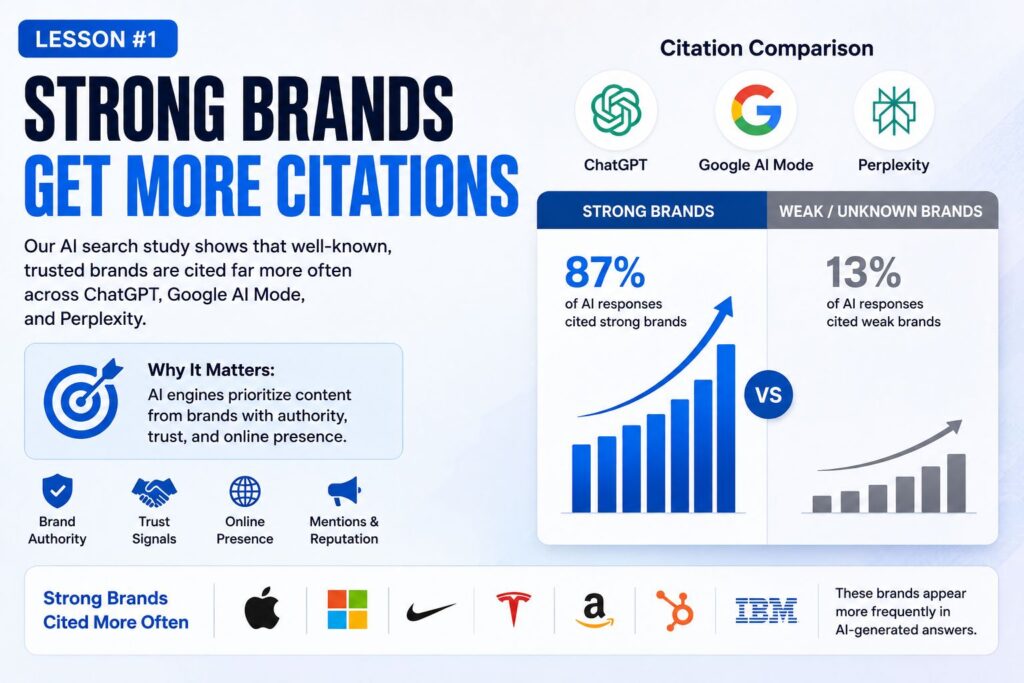
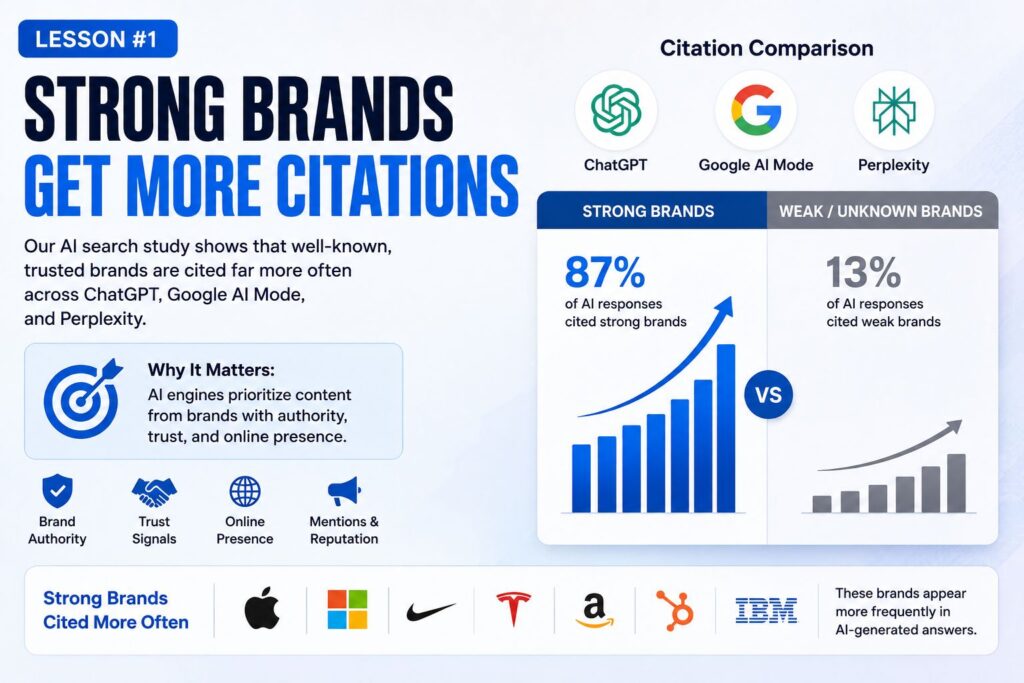
Lesson #1 – Strong Brands Get More Citations
“Lesson #1 – Strong Brands Get More Citations” means that AI search engines prefer well-known, trusted, and authoritative brands when selecting sources for answers. An AI Search Study shows that AI systems like ChatGPT, Perplexity, and Google AI Mode focus heavily on trust and credibility to avoid giving wrong information.
AI search engines do not only look at website design or keywords. Instead, they try to identify whether a brand is already trusted on the internet. If your brand is recognized, it has a much higher chance of being cited in AI-generated answers. This is because AI systems prefer safe and reliable sources.
A strong brand in AI search is defined by expertise, authority, and trust (E-E-A-T). It also includes real-world signals such as mentions on news websites, blogs, forums, and social media platforms. Even direct searches for your brand name show that people trust and recognize you. An AI Search Study confirms that these signals strongly influence how often a website gets cited.
Unlike traditional SEO, where backlinks were the main focus, AI search gives more importance to brand mentions across the internet. If your brand is discussed on platforms like YouTube, Reddit, LinkedIn, or podcasts, AI systems consider it more reliable and are more likely to include it in answers.
However, new or unknown websites may struggle to get citations, even if their content is good. AI prefers established sources to reduce the risk of incorrect information.
To become a strong brand for AI search, focus on one niche, build authority, and maintain a consistent online presence.
What Are Brand Mentions?
Brand Mentions mean any time your website, company, or brand name is mentioned on the internet. It does not always require a clickable link. Even if someone only writes your brand name in text, AI systems can still recognize it and understand that people are talking about you. An AI Search Study shows that brand mentions are becoming an important trust signal in modern AI search systems.
Examples of Brand Mentions
Forums: Someone on Reddit or Quora mentions your brand in a discussion.
Social Media: Your brand is discussed on platforms like X (Twitter), LinkedIn, or Facebook.
YouTube: A creator mentions your brand in a video or description.
Blogs/News: Another website talks about your brand in an article.
Brand Mentions vs Backlinks
Backlink: A clickable link that takes users to your website.
Brand Mention: Only your brand name is mentioned without any link.
Why Brand Mentions Matter for AI Search
AI search engines trust known brands because these systems prioritize risk reduction and verifiable authority. Instead of only analyzing keywords, Large Language Models (LLMs) study web-wide patterns to identify the safest and most reliable sources for answering user queries. The AI Search Study shows that authority signals now matter more than traditional SEO alone.
1. High-Trust Consensus: AI models are trained on massive datasets where established brands already have a strong historical presence. When a brand is repeatedly mentioned across news sites, industry reports, and forums, AI treats it as a safe and verified choice in every AI Search Study.
2. Third-Party Endorsements: AI systems rely on “citation clusters” such as reviews, buyer guides, and media coverage. These external validations strongly influence trust scoring because they are pre-vetted sources.
3. Entity Clarity: Known brands have consistent names, structured data, and clear information across the web, making them easier for AI to verify and classify correctly.
4. Minimizing User Risk: AI avoids recommending unreliable sources because it can damage user trust. Therefore, it prefers established brands with proven performance and reputation in AI Search Study results.
How To Build Brand Authority
Building brand authority means positioning your business as a trusted expert in your niche. In AI Search Study, authority is built through consistent value, credibility signals, and real audience engagement rather than just keywords or backlinks.
1. Publish Value-Driven Content: Share high-quality educational content like guides, case studies, and original insights. Focus on solving real problems instead of repeating existing information. This helps AI and users recognize your expertise in AI Search Study.
2. Social Proof & Testimonials: Display customer reviews, success stories, and ratings. Awards and media mentions also strengthen trust signals and improve perceived authority.
3. Topical Authority: Build structured content clusters around one niche instead of random topics. When multiple pages support one subject, AI systems understand your site as an expert source in AI Search Study.
4. Engagement & Thought Leadership: Stay active on social platforms, respond to your audience, and contribute guest posts or industry discussions. Authentic interaction builds long-term credibility.
Together, these strategies help establish strong brand authority, increasing your chances of being cited and trusted in AI-driven search results.
Lesson #2 – Topic Clusters Beat Single Articles
Many website owners make the mistake of publishing just one article on a topic and expecting strong rankings. In 2026, search engines and AI-powered search platforms prefer websites that demonstrate deep topical authority. This is why topic clusters outperform single articles.
Bad Example
A website publishes only one article:
- AI SEO Guide
While the article may be helpful, it does not prove expertise across the broader AI SEO landscape.
Good Example
A website creates a complete topic cluster with 10–20 related articles:
Pillar Article
- Complete AI SEO Guide for 2026
Cluster Articles
- AI SEO Tools Comparison
- AI Content Optimization Strategies
- AI Search Ranking Factors
- AI SEO for Startups
- AI SEO Case Studies
- AI Keyword Research Using AI
- Common AI SEO Mistakes
- AI SEO vs Traditional SEO
- AI Content Audits
- Future of AI Search
How Topic Clusters Work
Pillar Article
The pillar article is the main comprehensive guide covering the entire topic. It serves as the central hub for all related content.
Cluster Articles
Cluster articles focus on specific subtopics in greater detail. Each article answers a particular question or solves a specific problem.
Internal Links
All cluster articles link back to the pillar article, and the pillar article links to all cluster pages. This creates a strong content network that helps search engines understand topical relevance and authority.
AIToolMind Example
For AIToolMind, the pillar page could be:
“AI Guest Blogging: Complete Guide for Startups”
Supporting cluster articles could include:
- AI Guest Posting Benefits
- How to Find AI Guest Blogging Sites
- AI Guest Blogging for SaaS Companies
- AI Link Building Strategies
- Best AI Marketing Blogs for Guest Posts
- AI Content Marketing Trends
- AI Outreach Email Templates
- Guest Posting SEO Best Practices
- Building Authority with AI Content
- Measuring Guest Blogging ROI
Instead of ranking one article, AIToolMind can rank dozens of related pages, increasing topical authority, organic traffic, and visibility across AI search engines.
How to Build a Fully Automated Content Machine Using AI in 2026
Lesson #3 – Tables, Lists & FAQs Help AI Understand Content
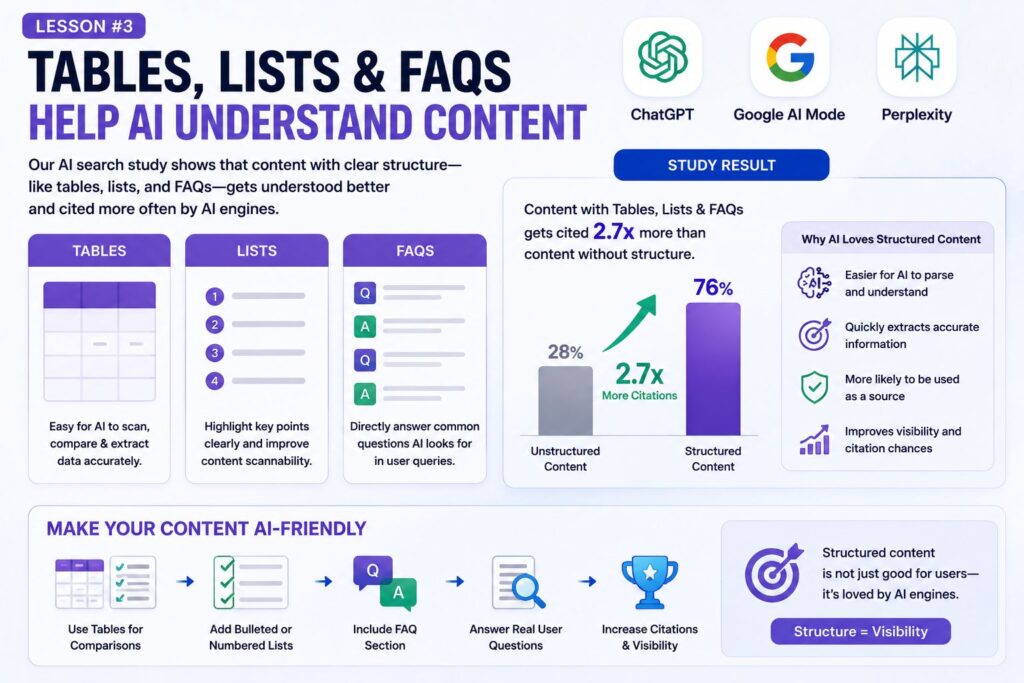
Modern AI search engines do more than read content—they analyze structure. Platforms like AI-powered search tools prefer content that is easy to scan, organize, and understand. This is why articles that include tables, bullet points, FAQs, and checklists often perform better than large blocks of text.
When information is clearly structured, AI systems can quickly identify key facts, compare data, and generate accurate answers for users. Well-formatted content also improves user experience, making visitors more likely to stay on the page and engage with your content.
What AI Engines Prefer
✓ Tables for comparisons and quick data access
✓ Bullet points for summarizing important information
✓ FAQs that answer common user questions
✓ Checklists that provide actionable steps
✓ Clear headings and subheadings
✓ Short, easy-to-read paragraphs
Example Table
| Content Format | Benefits for AI Search |
|---|---|
| Tables | Easy data extraction and side-by-side comparison. |
| Bullet Points | Highlight important information quickly and improve readability. |
| FAQs | Answer user questions directly and increase AI citation potential. |
| Checklists | Provide clear, step-by-step guidance for users and AI systems. |
| Headings | Improve topic organization and content structure. |
| Internal Links | Help AI understand relationships between related pages and topics. |
The table above allows AI systems to identify important information instantly without analyzing long paragraphs.
Example Checklist
AI-Friendly Content Checklist
- Use descriptive headings
- Add comparison tables where relevant
- Include bullet point summaries
- Answer common questions in an FAQ section
- Link related articles together
- Keep paragraphs concise and focused
FAQ sections are especially valuable because they mirror the way users search online. Many AI engines pull answers directly from concise question-and-answer formats. By including relevant FAQs, you increase the chances of your content being cited, summarized, or featured in AI-generated responses.
The easier your content is for AI to scan and interpret, the greater your chances of improving visibility, earning citations, and building authority in AI-driven search results.
Lesson #4 – Backlinks Still Matter
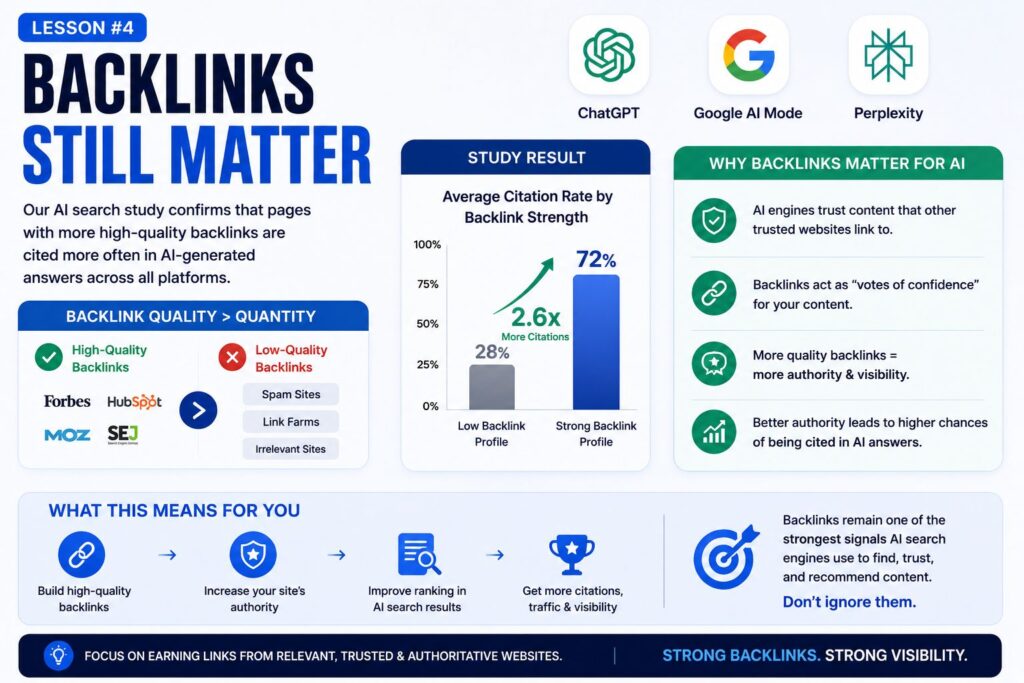
Despite the rise of AI-powered search engines, backlinks remain one of the strongest signals of authority and trust. AI search systems evaluate not only the quality of your content but also who is referencing and recommending your website. When reputable websites link to your content, it signals that your information is valuable, trustworthy, and worth citing.
This is why websites with strong backlink profiles often receive greater visibility in both traditional search results and AI-generated answers. Authority sites are more likely to be trusted by AI engines because they have earned recognition from other respected sources within their industry.
Guest Posts
Guest posting involves publishing articles on relevant websites within your niche. In return, you typically receive a backlink to your website. This helps build authority, referral traffic, and brand visibility.
Digital PR
Digital PR focuses on earning mentions and links from news sites, industry publications, and media outlets. Original research, case studies, surveys, and expert insights can attract valuable media coverage and high-authority backlinks.
Link Insertions
Link insertions involve adding your website link to existing articles on relevant websites where your content provides additional value. This can be an efficient way to acquire contextual backlinks.
Niche Backlinks
Links from websites within your specific industry are highly valuable because they demonstrate topical relevance. A technology website linking to an AI blog, for example, carries more relevance than a link from an unrelated niche.
Why Backlinks Matter for AI Search
AI engines analyze trust signals across the web. When multiple reputable websites reference your content, AI systems gain confidence in your expertise. The stronger your backlink profile, the more likely your content is to be viewed as authoritative.
For brands like AIToolMind, earning backlinks through guest posts, digital PR campaigns, link insertions, and niche-relevant websites helps strengthen domain authority, improve rankings, and increase the likelihood of being cited by AI-powered search platforms.
Lesson #5 – User Intent Is More Important Than Keywords
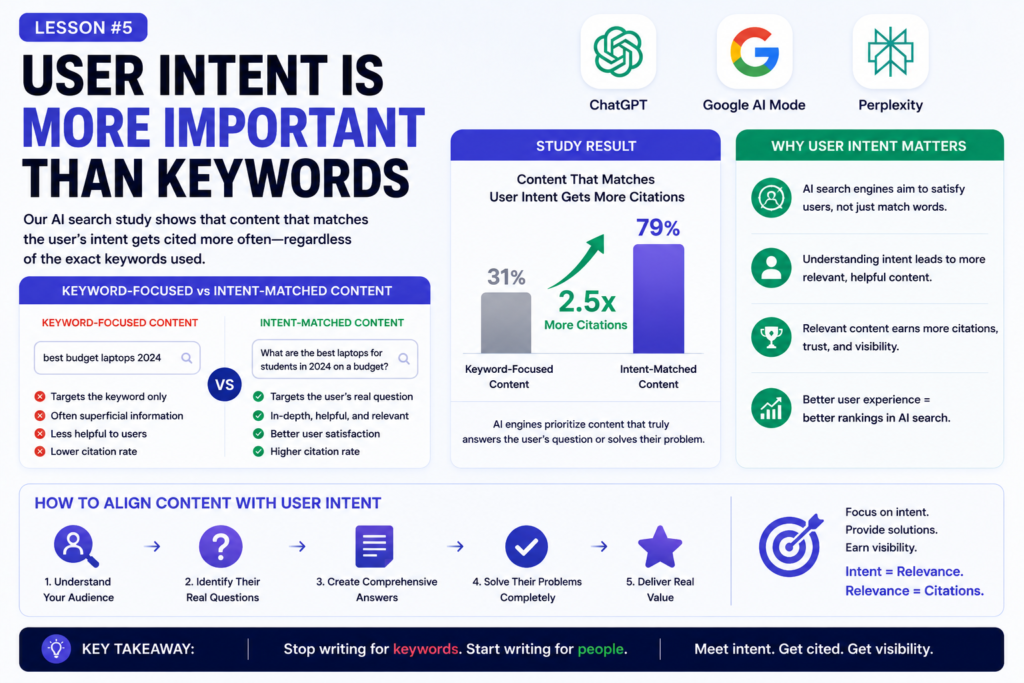
For many years, SEO focused heavily on keywords. Website owners would repeat the same keyword multiple times in an article to improve rankings. Today, AI-powered search engines are much smarter. Instead of focusing only on keywords, they prioritize user intent—the actual reason behind a search query.
User intent refers to what a person wants to learn, solve, compare, or achieve when searching online. AI engines analyze the meaning of a query and look for content that provides the most helpful answer, not simply the highest keyword density.
Example
Keyword-Focused Approach
Keyword: AI SEO
Article Title:
- AI SEO Guide
- AI SEO Tips
- AI SEO Strategies
While these titles target the keyword, they may not fully address what users are actually looking for.
Intent-Focused Approach
User Question:
- How do I rank in AI search results?
Better Article Title:
This title directly addresses the user’s goal and provides a clear solution.
How to Optimize for User Intent
Instead of asking:
- What keyword should I target?
Ask:
- What question is the user trying to answer?
- What problem are they trying to solve?
- What information do they need next?
- What action do they want to take?
Examples of Intent-Based Content
| User Question | Better Content Topic |
|---|---|
| What is AI SEO? | Beginner's Guide to AI SEO |
| How do I rank in AI search? | Step-by-Step AI Search Ranking Guide |
| Which AI SEO tools are best? | Best AI SEO Tools Compared |
| Why is my content not ranking? | Common AI SEO Mistakes and Fixes |
AI engines reward content that solves problems clearly and completely. If your article answers real user questions, provides practical solutions, and delivers useful information, it has a much better chance of being recommended, cited, and ranked. Focus on helping users first, and keywords will naturally fit into the content.
AI Search Optimization Checklist for 2026
As AI-powered search engines continue to evolve, websites must focus on trust, authority, and content quality rather than relying solely on traditional SEO tactics. Use this checklist to ensure your content is optimized for AI search visibility in 2026.
AI Search Optimization Checklist
✓ Build Brand Mentions across authoritative websites and industry publications.
✓ Earn High-Quality Backlinks through guest posting, digital PR, and niche outreach.
✓ Strengthen EEAT (Experience, Expertise, Authoritativeness, and Trustworthiness) throughout your content.
✓ Use Tables to organize information and make it easier for AI systems to extract key insights.
✓ Add FAQ Sections that answer common user questions directly and clearly.
✓ Publish Fresh Content regularly to keep information accurate and relevant.
✓ Create Strong Internal Links between related articles and important pages.
✓ Develop Topic Clusters around core subjects to build topical authority.
✓ Include Original Examples such as case studies, data, screenshots, and real-world experiences.
✓ Implement Entity SEO by clearly referencing brands, products, people, and concepts that help AI understand context.
Final Thought
The websites that perform best in AI search are those that demonstrate expertise, provide helpful answers, and build authority across the web. By following this checklist consistently, you can improve your chances of being cited, recommended, and trusted by AI search engines in 2026 and beyond.
FAQs – AI Search Study: 5 SEO Lessons From Testing ChatGPT, Google AI Mode
1. What is AI Search Study in SEO?
AI Search Study refers to analyzing how AI-powered search engines like ChatGPT and Google AI Mode rank, select, and cite content. It helps understand what type of content performs best in AI-driven results.
2. How is AI SEO different from traditional SEO?
Traditional SEO focuses on keywords and backlinks, while AI SEO focuses more on user intent, content structure, authority, and clarity. AI systems prefer well-organized, meaningful content over keyword stuffing.
3. Why are topic clusters important in AI SEO?
Topic clusters help AI understand your website’s expertise in a specific niche. Instead of one article, multiple related articles improve topical authority and increase chances of ranking and citation.
4. Do backlinks still matter in AI search ranking?
Yes, backlinks are still very important. AI systems use them as trust signals. High-quality links from authority websites increase credibility and improve visibility in AI-generated answers.
5. What type of content performs best in AI search results?
Content that is structured, intent-focused, and easy to understand performs best. This includes FAQs, tables, bullet points, internal linking, and real examples that directly answer user questions.