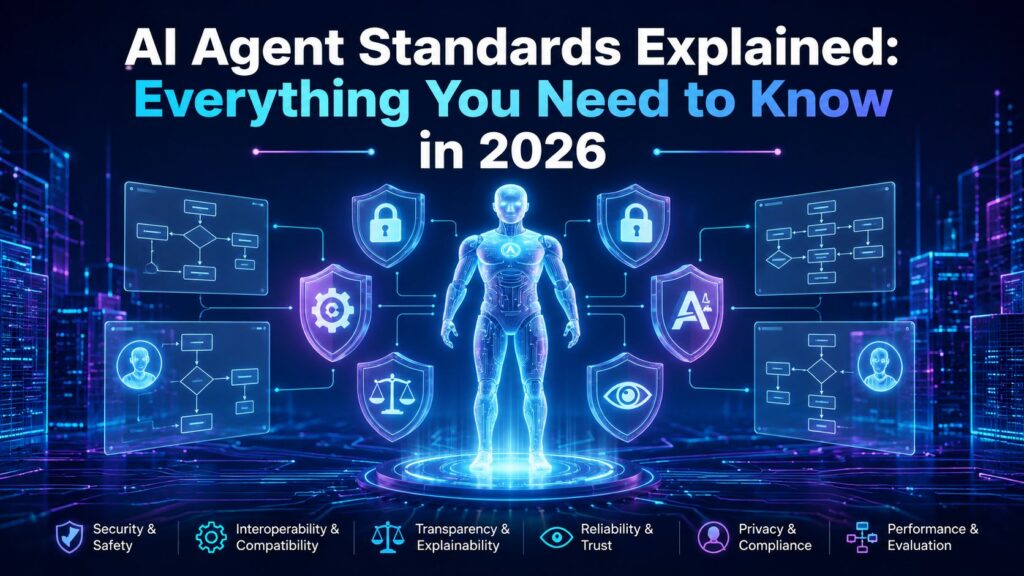
AI Agent Standards Explained: Everything You Need to Know in 2026
Discover the latest AI Agent Standards, interoperability protocols, security frameworks, governance models, and best practices shaping the future of intelligent AI agents in 2026.
Artificial intelligence is evolving at an extraordinary pace. Recent research even suggests a phenomenon similar to Moore’s Law, where the length and complexity of tasks that AI agents can successfully complete doubles every 3 to 7 months. This rapid progress is redefining how businesses and professionals work, making AI Agent Standards more important than ever.
We are quickly moving beyond traditional chatbots into a new era of autonomous AI systems. Modern AI agents can execute multi-step workflows, reason through complex problems, and interact with multiple applications in real time. As organizations adopt these technologies, following AI Agent Standards ensures reliability, security, and consistent performance.
Explore More AI Resources: AIToolMind
Long-Horizon Task Execution
One of the biggest breakthroughs is the ability of AI agents to handle long-horizon tasks. Instead of responding to a single prompt, they can now complete workflows that once required hours—or even days—of human effort. From software development to advanced data analysis, these systems maintain context, make informed decisions, and deliver highly accurate results. This shift highlights why AI Agent Standards are becoming a critical benchmark for enterprise AI adoption.
Connected Agentic Ecosystems
Another major advancement is the rise of connected AI ecosystems. Enterprise platforms such as SAP and Salesforce now support technologies like the Model Context Protocol (MCP), allowing AI agents to securely communicate, share context, and execute actions across multiple software environments. These interoperable systems are setting new expectations for collaboration, making AI Agent Standards essential for building scalable and trustworthy AI solutions.
The Future of Hybrid Work
Businesses are also embracing hybrid AI workflows. A growing industry approach suggests that AI agents can efficiently manage around 70% of repetitive, operational, and preparatory work, while humans focus on the remaining 30% that requires strategic thinking, creativity, and critical judgment. This balanced partnership improves productivity without replacing human expertise, reinforcing the value of AI Agent Standards in creating effective human-AI collaboration.
What Are AI Agent Standards?
AI Agent Standards are a set of guidelines, protocols, and best practices that define how AI agents should communicate, make decisions, exchange information, and interact with other systems. These standards help ensure that AI agents remain secure, reliable, and compatible across different platforms, tools, and organizations. As businesses increasingly rely on autonomous AI, having common standards is essential for building systems that can work together without unnecessary complexity.
One emerging standard is the Model Context Protocol (MCP), which enables AI assistants to connect securely with external tools and data sources.
AI Agent Standards at a Glance
| Standard Area | Purpose | Why It Matters in 2026 |
|---|---|---|
| Safety | Prevent harmful or unsafe AI actions | Protects users and organizations |
| Transparency | Explain how AI makes decisions | Builds user trust and accountability |
| Privacy | Secure user and business data | Meets modern privacy expectations |
| Security | Prevent attacks and unauthorized access | Essential for enterprise AI adoption |
| Reliability | Deliver consistent and accurate outputs | Reduces errors and downtime |
| Human Oversight | Keep humans in control of critical decisions | Prevents misuse and improves accountability |
| Interoperability | Enable agents to work across different tools and platforms | Supports scalable AI ecosystems |
| Compliance | Align with legal and industry regulations | Helps organizations avoid legal risks |
AI Models vs. AI Agents: What's the Difference?
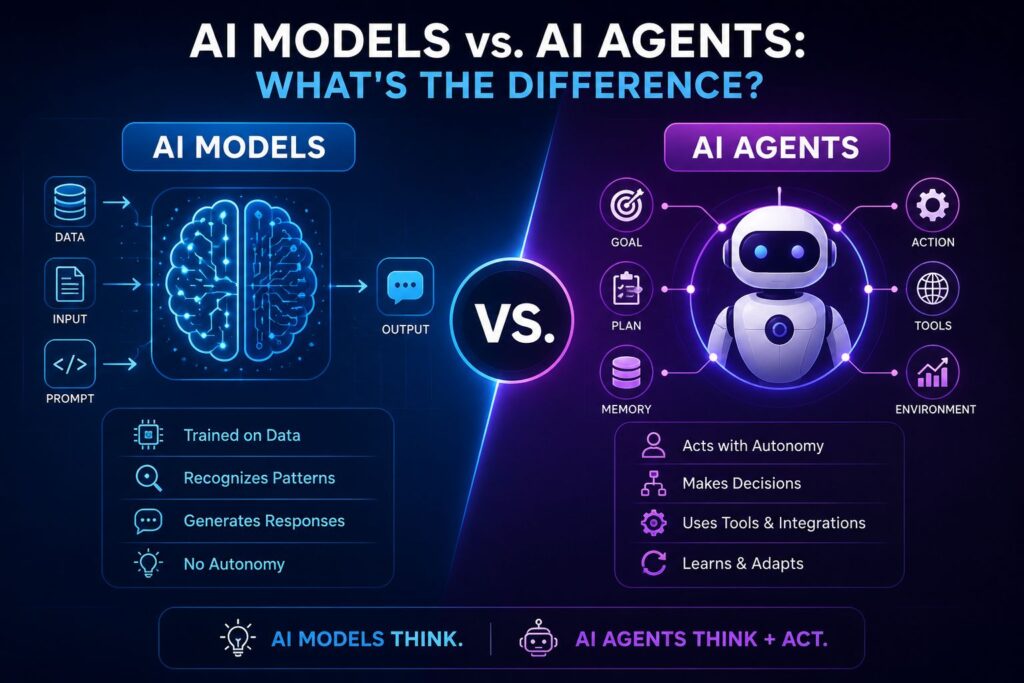
Although the terms are often used interchangeably, AI models and AI agents are not the same.
An AI model is the intelligence behind the system. It is trained to understand language, recognize patterns, generate content, or make predictions based on the data it has learned. On its own, an AI model responds to prompts but does not independently take action.
An AI agent, on the other hand, goes beyond generating responses. It uses one or more AI models to plan tasks, make decisions, access external tools, retrieve information, and complete multi-step workflows with minimal human intervention. In simple terms, the AI model is the “brain,” while the AI agent is the “worker” that uses that intelligence to accomplish real-world tasks.
Learn more in our guide: How Google AI Search Is Changing SEO
Why Are AI Agent Standards Needed?
As AI agents become part of everyday business operations, they must interact with different applications, databases, cloud services, and even other AI agents. Without common standards, each platform may use its own communication methods, security rules, and data formats, making collaboration difficult and increasing the risk of errors.
AI Agent Standards solve these challenges by creating a common framework for interoperability, security, and governance. They help developers build AI systems that are easier to integrate, businesses deploy automation with greater confidence, and users benefit from more reliable and trustworthy AI experiences. As the AI ecosystem continues to grow in 2026 and beyond, these standards will play a critical role in enabling safe and scalable AI adoption.
Why AI Agent Standards Matter
AI agents are becoming an essential part of modern workplaces, helping organizations automate tasks, improve productivity, and make faster decisions. However, as businesses adopt AI across multiple platforms and departments, consistency becomes just as important as capability. This is where AI Agent Standards make a real difference. They provide a shared framework that allows AI systems to operate safely, reliably, and efficiently.
Related Guide: High-Quality Backlinks for GEO & SEO
Better Interoperability
Organizations rarely rely on a single software platform. AI agents often need to connect with CRMs, cloud services, databases, communication tools, and business applications. Common standards ensure these systems can exchange information smoothly, reducing integration challenges and creating seamless workflows.
Building Trust
Businesses and users are more likely to adopt AI when they understand how it makes decisions and handles information. Standardized practices improve transparency, accountability, and consistency, making AI agents more dependable in real-world environments.
Stronger Security
AI agents frequently access sensitive systems and business data. Without clear security guidelines, they can become vulnerable to unauthorized access or misuse. Well-defined standards help protect systems through secure authentication, controlled permissions, and responsible access management.
Protecting Data Privacy
As AI processes customer information, financial records, and confidential business data, privacy becomes a top priority. Standards encourage responsible data handling, regulatory compliance, and secure information sharing, helping organizations reduce privacy risks and maintain user confidence.
Reliable Automation
Businesses depend on AI agents to perform tasks accurately and consistently. Standardized workflows reduce errors, improve performance, and ensure AI agents behave predictably, even when working across different environments or handling complex processes.
Vendor Compatibility
Companies often use AI solutions from multiple technology providers. Without shared standards, integrating these tools can become expensive and time-consuming. Common frameworks improve compatibility, allowing organizations to combine different AI platforms without being locked into a single vendor.
Accelerating Enterprise Adoption
Large organizations require AI systems that are scalable, secure, and easy to manage. AI Agent Standards provide the foundation for enterprise-wide deployment by simplifying integration, supporting governance, and reducing operational risks. As AI continues to evolve, these standards will play a key role in helping businesses adopt intelligent automation with greater confidence.
How AI Agents Work
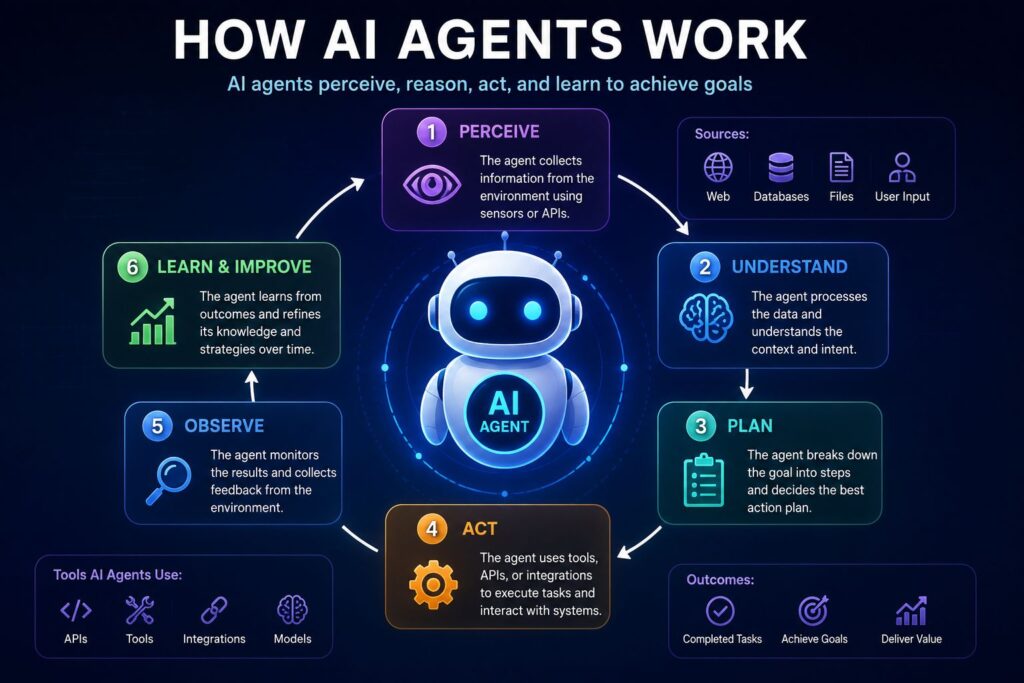
Unlike traditional AI models that simply respond to prompts, AI agents are designed to achieve specific goals by making decisions, using external tools, and adapting based on new information. Instead of performing a single task, they follow a structured workflow that allows them to complete complex objectives with minimal human intervention.
Related Guide: 15 Best Free AI Tools for Content Creators in 2026
Setting a Goal
Every AI agent starts with a goal. This could be answering a customer inquiry, generating a report, booking a meeting, analyzing business data, or automating an entire workflow. The goal defines what the agent needs to accomplish and guides every decision it makes.
Planning the Best Approach
Once the objective is clear, the AI agent creates a plan. It breaks the task into smaller, manageable steps and determines the most efficient sequence of actions. If new information becomes available during execution, the agent can adjust its plan without starting over.
Reasoning and Decision-Making
AI agents don’t simply follow fixed instructions. They evaluate available information, compare possible solutions, and choose the action that best aligns with the original goal. This reasoning capability helps them solve problems and adapt to changing situations.
Using Memory
Memory allows an AI agent to remember previous conversations, completed tasks, user preferences, or important business data. By retaining relevant context, the agent can deliver more accurate responses and avoid repeating unnecessary work.
Accessing Tools and APIs
To complete real-world tasks, AI agents often connect with external tools and APIs. They can retrieve information from databases, interact with CRM systems, send emails, generate reports, access cloud services, or communicate with other software platforms. These integrations significantly expand what an AI agent can accomplish.
Taking Action
After gathering the required information, the AI agent performs the requested task. Depending on the workflow, it may generate content, update records, schedule appointments, process data, or trigger automated business processes.
Learning from Human Feedback
Human feedback plays an important role in improving AI performance. Users can review results, correct mistakes, or provide additional instructions. The agent uses this feedback to refine future responses and make better decisions over time.
A Simple AI Agent Workflow
User
↓
AI Agent
↓
Planning
↓
Tools / APIs
↓
Action
↓
Feedback
↓
Memory
This continuous workflow enables AI agents to learn from experience, make informed decisions, and automate increasingly complex tasks. As AI technology continues to evolve, this cycle will become even more efficient, allowing intelligent agents to deliver faster, smarter, and more reliable results across a wide range of industries.
Core Components of AI Agent Standards
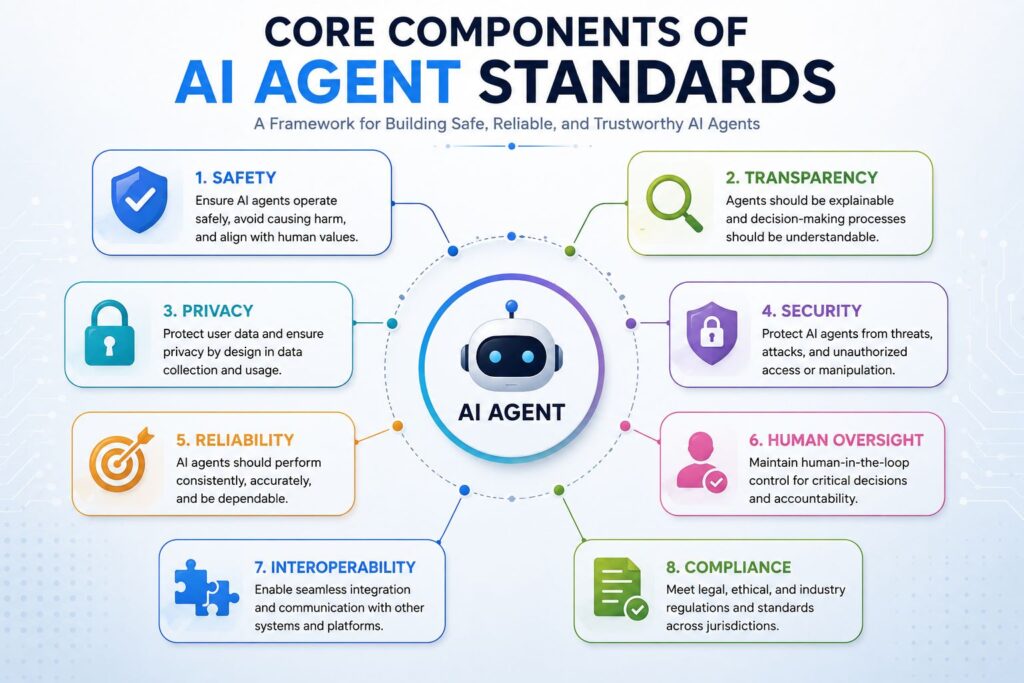
AI agent standards define the essential building blocks that allow intelligent agents to operate reliably, securely, and efficiently across different applications and platforms. As AI agents become more autonomous, they need standardized ways to communicate, access tools, manage memory, protect sensitive information, and interact with humans. Without these standards, every AI system would follow different rules, making integration difficult and increasing security and reliability risks.
Continue reading: High-Quality Backlinks for GEO & SEO
Communication Protocols
Communication protocols define how AI agents exchange information with users, software applications, databases, APIs, and other AI agents. They establish a common language that enables systems developed by different organizations to understand one another without requiring custom integrations for every interaction. Standardized communication improves compatibility, reduces development complexity, and supports seamless collaboration across platforms.
Memory Management
Communication protocols define how AI agents exchange information with users, software applications, databases, APIs, and other AI agents. They establish a common language that enables systems developed by different organizations to understand one another without requiring custom integrations for every interaction. Standardized communication improves compatibility, reduces development complexity, and supports seamless collaboration across platforms.
Planning Systems
Planning systems enable AI agents to break complex objectives into manageable tasks before taking action. Instead of responding immediately to every request, an intelligent agent analyzes the overall goal, identifies dependencies, prioritizes actions, and develops a logical sequence for completing the work efficiently.
Modern planning systems often combine reasoning models with task decomposition algorithms. Large objectives are divided into smaller subtasks, each with defined inputs, outputs, and success criteria. The agent continuously evaluates progress, adapts to new information, and modifies the execution plan when unexpected situations occur.
Tool Integration
Tool integration allows AI agents to extend their capabilities beyond text generation by connecting with external software, APIs, databases, search engines, cloud services, and enterprise applications. Rather than relying solely on internal knowledge, agents can retrieve live information, perform calculations, generate reports, access business systems, and automate real-world workflows.
Modern AI agents commonly integrate with productivity platforms, CRM software, programming environments, communication tools, payment systems, document repositories, and cloud infrastructure. Standardized APIs make these integrations consistent and easier to maintain across different platforms.
Authentication
Authentication verifies the identity of users, AI agents, applications, and connected services before granting access to protected systems. It serves as the first line of defense against unauthorized access and cyber threats within AI-powered environments.
Authorization
Authorization determines what actions an authenticated AI agent or user is allowed to perform after identity verification has been completed. While authentication answers “Who are you?”, authorization answers “What are you permitted to do?”
Modern authorization systems commonly use role-based access control (RBAC), attribute-based access control (ABAC), policy-based permissions, and least-privilege principles. These approaches ensure users and AI agents receive only the minimum permissions required for completing assigned tasks.
Data Privacy
Data privacy ensures AI agents collect, process, store, and share information responsibly while respecting legal requirements and user expectations. Since AI systems frequently handle personal, financial, healthcare, and business information, protecting sensitive data has become a critical requirement for trustworthy AI.
Privacy standards emphasize transparency, consent, data minimization, encryption, secure storage, anonymization, and controlled retention periods. AI agents should collect only the information necessary for completing their assigned tasks and avoid storing unnecessary personal details.
Observability & Logging
Observability and logging provide visibility into how AI agents operate during execution. They enable developers, administrators, and security teams to understand agent behavior, diagnose problems, monitor performance, and verify that systems operate according to defined policies.
Logging records important events such as user requests, tool usage, API calls, model decisions, authentication attempts, errors, execution times, and system responses. These records create an audit trail that supports troubleshooting, compliance reporting, and security investigations.
Error Handling
Error handling enables AI agents to detect, report, recover from, and learn from unexpected situations without causing unnecessary failures. Since AI systems interact with multiple tools, APIs, databases, and external services, unexpected errors are inevitable. A well-designed error handling strategy ensures these problems do not disrupt the entire workflow.
Common issues include network failures, invalid inputs, unavailable services, authentication errors, rate limits, software bugs, and incomplete responses from external tools. AI agents should recognize these situations, generate meaningful error messages, retry failed operations when appropriate, and offer alternative solutions if recovery is not possible.
Human Oversight
Human oversight ensures that people remain responsible for supervising AI systems, reviewing important decisions, and intervening when necessary. Although AI agents can automate many complex tasks, human judgment remains essential for ethical decision-making, accountability, and risk management.
International AI standards are also being developed through ISO/IEC JTC 1/SC 42, which focuses on artificial intelligence standardization.
Popular AI Agent Frameworks and Emerging Standards
As AI agents continue to evolve from simple assistants into autonomous systems, developers need reliable frameworks and standardized protocols to build scalable, secure, and collaborative applications. This is where AI Agent Standards become essential. They define how agents communicate, share context, access tools, and coordinate tasks across different environments. Without AI Agent Standards, organizations would struggle to integrate agents created by different vendors or platforms.
Learn more in our guide: How Google AI Search Is Changing SEO
Model Context Protocol (MCP)
Model Context Protocol (MCP) is an open protocol designed to standardize how AI models connect with external data sources, APIs, databases, files, and software tools. Instead of creating custom integrations for every application, MCP provides a consistent interface that allows AI agents to retrieve context and perform actions using a common protocol.
MCP separates the AI model from external resources while maintaining secure communication. Developers can expose business systems, document repositories, cloud services, or internal applications through MCP servers, allowing AI agents to access information without requiring custom code for every integration.
Agent-to-Agent (A2A) Communication Concepts
Agent-to-Agent (A2A) communication refers to the ability of multiple AI agents to exchange information, coordinate activities, and collaborate on complex tasks. Instead of relying on a single intelligent system, organizations can deploy specialized agents that communicate with one another to complete different parts of a workflow.
LangGraph
LangGraph is an open-source framework designed for building stateful AI agent workflows using graph-based architectures. Instead of executing prompts sequentially, LangGraph represents workflows as interconnected nodes where each node performs a specific operation such as reasoning, tool execution, memory retrieval, or decision-making.
CrewAI
CrewAI is a multi-agent orchestration framework that allows developers to build teams of AI agents working together toward a shared objective. Instead of assigning every responsibility to one large model, CrewAI enables organizations to create specialized agents with distinct roles, responsibilities, and expertise.
AutoGen
AutoGen is a framework that simplifies the development of conversational and collaborative AI agents capable of solving complex problems together. Developed to support multi-agent interactions, AutoGen enables agents to communicate through structured conversations while using tools, APIs, programming environments, and human feedback when necessary.
Semantic Kernel
Semantic Kernel is Microsoft’s open-source development framework for integrating large language models into enterprise applications. It combines AI capabilities with traditional programming by allowing developers to orchestrate prompts, business logic, APIs, memory, and plugins within a single application architecture.
AI Agent Security Standards
As AI agents become more capable of accessing business systems, cloud platforms, APIs, and sensitive data, security must be a core part of their design. AI Agent Standards place a strong emphasis on protecting identities, securing communications, controlling permissions, and maintaining transparency throughout every interaction. Without proper safeguards, autonomous agents could expose confidential information, misuse connected tools, or become targets for cyberattacks.
AI Governance and Ethical Standards
As AI systems become more autonomous and influential in business, healthcare, education, finance, and public services, organizations must ensure they are developed and deployed responsibly. AI Agent Standards extend beyond technical requirements by incorporating governance and ethical principles that guide how AI agents make decisions, process data, and interact with people. Strong governance establishes clear policies, accountability, and oversight throughout the AI lifecycle, while ethical standards help minimize risks such as bias, privacy violations, and misuse of artificial intelligence.
Fairness and non-discrimination
Fairness ensures that AI systems treat individuals and groups equitably without producing discriminatory outcomes. Bias can arise from training data, algorithms, or system design, leading to unfair decisions in areas such as hiring, lending, healthcare, and education. Organizations should regularly evaluate AI models for bias, use diverse datasets, and implement fairness testing to reduce unequal outcomes. Promoting fairness increases public trust and supports responsible AI development.
Transparency and Explainability
Transparency allows users and stakeholders to understand how AI systems reach their conclusions. Since many advanced AI models operate as complex “black boxes,” organizations should provide meaningful explanations for important decisions whenever possible. Explainable AI techniques, clear documentation, and model reporting improve user confidence, simplify auditing, and help organizations meet regulatory requirements.
Accountability
Accountability ensures that responsibility for AI systems is clearly assigned throughout their lifecycle. Organizations should define ownership for model development, deployment, monitoring, and maintenance. Governance teams must establish approval processes, incident response plans, and regular audits to ensure AI systems remain compliant with internal policies and external regulations. Clear accountability strengthens trust and supports responsible decision-making.
Safety and Robustness
AI systems should perform reliably under both normal and unexpected conditions. Safety measures include rigorous testing, continuous monitoring, fallback mechanisms, and secure deployment practices. Robust AI agents should resist manipulation, recover from failures gracefully, and maintain consistent performance while minimizing risks to users and organizations.
Privacy and Data Protection
Protecting user privacy is a fundamental requirement for responsible AI. Organizations should collect only necessary data, encrypt sensitive information, implement secure storage, and comply with applicable privacy regulations. Users should understand how their information is used and, where appropriate, have the ability to access, modify, or delete their personal data.
Key AI Governance Frameworks and Standards
Several internationally recognized frameworks help organizations implement responsible AI practices while aligning with modern AI Agent Standards.
- UNESCO Recommendation on the Ethics of AI: Provides a global, human rights-centered framework emphasizing fairness, transparency, proportionality, human oversight, environmental sustainability, and international cooperation.
- NIST AI Risk Management Framework (AI RMF): Developed by the U.S. National Institute of Standards and Technology, this voluntary framework helps organizations identify, assess, manage, and continuously monitor AI-related risks to build trustworthy AI systems.
- EU AI Act: Introduces a risk-based regulatory approach by classifying AI applications into different risk categories, ranging from unacceptable risk to minimal risk. Higher-risk AI systems must meet stricter compliance, documentation, transparency, and safety requirements before deployment.
The NIST AI Risk Management Framework (AI RMF) provides practical guidance for developing trustworthy and responsible AI systems.
Implementing AI Governance in Organizations
Successful AI governance requires embedding ethical principles throughout the entire AI lifecycle—from data collection and model development to deployment, monitoring, and retirement. Organizations often establish multidisciplinary AI governance committees that include engineers, legal experts, compliance officers, cybersecurity professionals, and business leaders.
By integrating governance, ethics, security, and oversight into everyday development practices, organizations can build trustworthy AI solutions that comply with regulations, reduce operational risks, strengthen public confidence, and support the long-term adoption of AI Agent Standards across industries.
Benefits of AI Agent Standards for Businesses
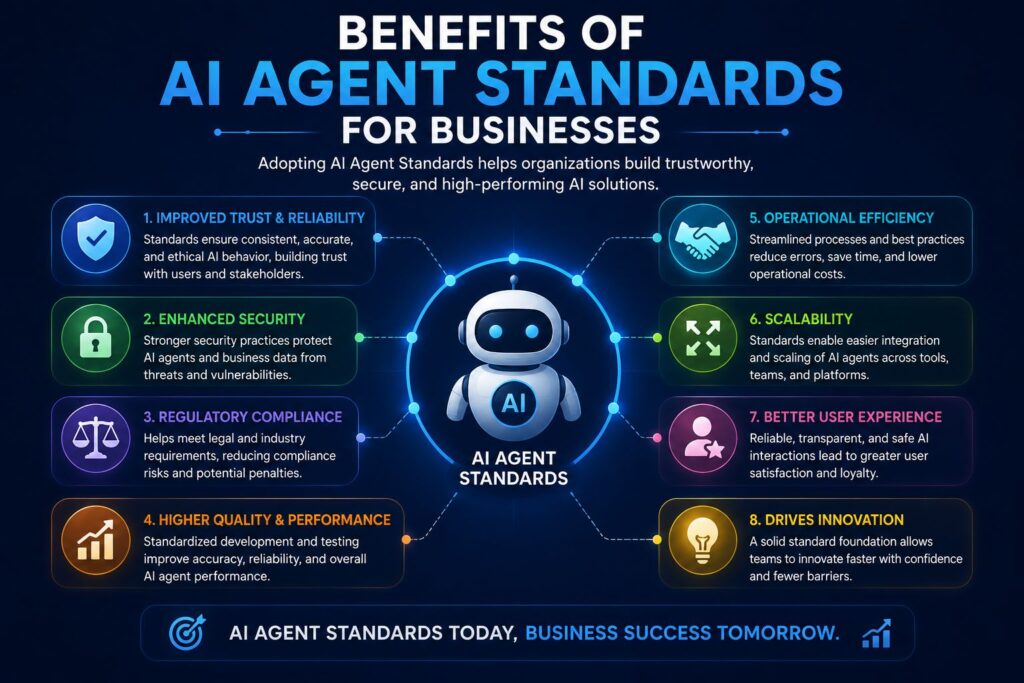
Implementing AI Agent Standards provides businesses with a structured foundation for building secure, reliable, and scalable AI solutions. As organizations increasingly rely on AI agents for customer support, software development, business automation, research, and decision-making, standardized practices help reduce risks while improving operational efficiency. Instead of managing disconnected AI systems, businesses can deploy interoperable agents that communicate effectively, integrate with existing software, and follow consistent security and governance policies. Adopting AI Agent Standards also improves compliance, strengthens customer trust, and prepares organizations for future AI innovations.
Related Guide: AI Search Study: 5 SEO Lessons From Testing ChatGPT, Google AI Mode & More
Improved Interoperability
Standardized protocols enable AI agents, APIs, cloud services, and enterprise applications to communicate seamlessly. This reduces integration challenges, simplifies software development, and allows businesses to connect AI systems from multiple vendors without extensive customization.
Enhanced Security and Compliance
Strong AI Agent Standards include authentication, authorization, encryption, access control, and audit logging to protect sensitive business data. Organizations can better meet regulatory requirements while reducing cybersecurity risks associated with autonomous AI systems.
Higher Productivity and Automation
AI agents built on standardized frameworks automate repetitive tasks such as customer service, document processing, data analysis, scheduling, and workflow management. Employees can focus on strategic work while AI handles routine operations, increasing overall productivity.
Better Scalability
As business requirements grow, standardized AI architectures make it easier to deploy additional agents, integrate new tools, and expand automation across departments. Organizations can scale AI initiatives without rebuilding their infrastructure.
Reduced Development Costs
Using common protocols, reusable components, and established frameworks minimizes custom development and maintenance efforts. Development teams spend less time solving compatibility issues and more time delivering innovative AI solutions.
Related Guide: How Google AI Search Is Changing SEO
Improved Reliability and Performance
Standardized planning, memory management, error handling, and monitoring help AI agents perform consistently across different environments. Continuous observability enables organizations to identify issues early and maintain high system availability.
Stronger Collaboration
Modern AI agents can work together by sharing context, delegating responsibilities, and coordinating workflows. This collaborative approach improves efficiency in complex business processes such as software development, research, marketing, and customer support.
Future-Proof AI Infrastructure
As the AI ecosystem evolves, organizations that adopt AI Agent Standards can more easily integrate emerging frameworks, communication protocols, and enterprise tools. This flexibility protects long-term technology investments while supporting continuous innovation and sustainable Benefits of AI Agent Standards for Developers
For developers, AI Agent Standards simplify the process of designing, deploying, and maintaining intelligent applications. Instead of building custom integrations and communication methods for every project, developers can rely on standardized protocols, reusable frameworks, and consistent best practices. This accelerates development, reduces technical complexity, and improves compatibility across different AI platforms. As enterprise AI adoption grows, following AI Agent Standards also helps developers create secure, scalable, and future-ready solutions that integrate seamlessly with modern software ecosystems.
Related Guide: Technology Write for Us
Faster Development
Standardized architectures eliminate the need to build every component from scratch. Developers can reuse existing protocols for communication, memory, authentication, and tool integration, significantly reducing development time and enabling faster product releases.
Easier Integration
Modern AI applications often connect with APIs, databases, cloud platforms, and third-party services. AI Agent Standards provide consistent interfaces that simplify integration and reduce compatibility issues when working across different vendors and technologies.
Better Code Maintainability
Following common standards results in cleaner architecture, modular components, and reusable code. Development teams can more easily update, debug, and extend AI applications without disrupting existing functionality.
Improved Collaboration
When developers follow standardized practices, team members can understand system architecture more quickly and contribute efficiently. Consistent workflows also make collaboration easier across engineering, DevOps, security, and product teams.
Stronger Security
Security standards built into AI agent frameworks include authentication, authorization, encryption, secrets management, and secure API communication. These practices reduce vulnerabilities while helping developers build trustworthy AI applications from the beginning.
Developers should also follow the OWASP Top 10 for Large Language Model Applications to reduce security risks in AI systems.
Simplified Testing and Debugging
Standardized workflows, structured logging, observability tools, and error-handling mechanisms make it easier to identify bugs, monitor performance, and troubleshoot issues. Developers spend less time diagnosing problems and more time improving product quality.
Scalability and Flexibility
Applications built using AI Agent Standards can scale more easily as business requirements grow. Developers can add new AI agents, external tools, workflows, and services without redesigning the entire system, making future expansion much simpler.
Future-Proof Development
The AI ecosystem is evolving rapidly with new frameworks, communication protocols, and enterprise platforms. By adopting AI Agent Standards, developers create applications that remain compatible with emerging technologies, reducing long-term maintenance costs and protecting their software investments.
Overall, AI Agent Standards empower developers to build reliable, interoperable, secure, and high-performance AI applications more efficiently while supporting long-term innovation and enterprise adoption.
business growth.
Real-World Use Cases of AI Agent Standards
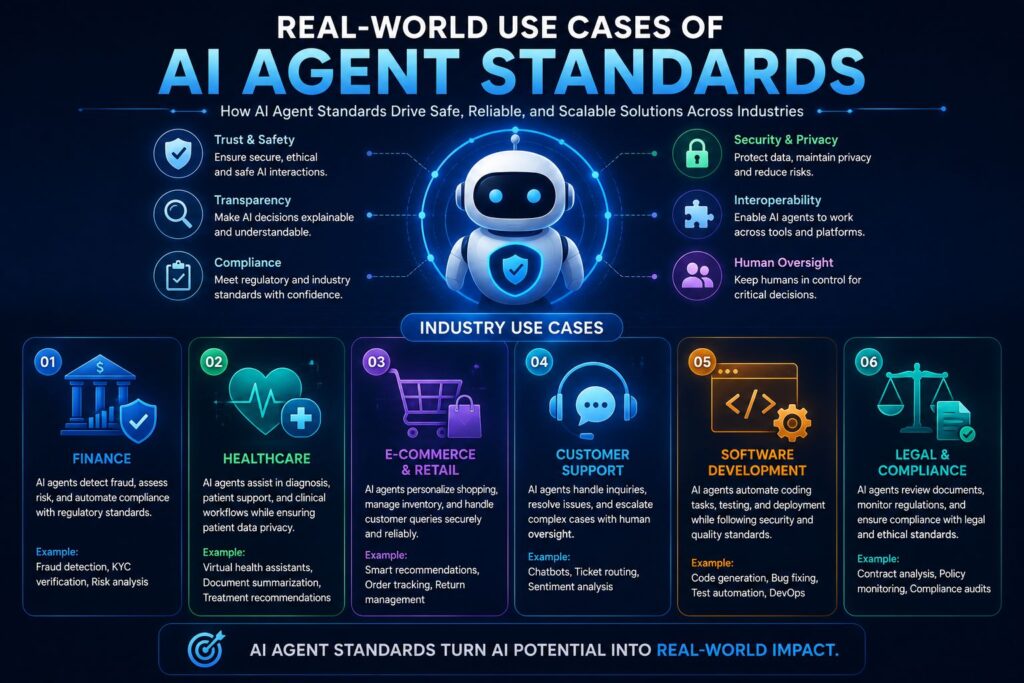
AI Agent Standards enable organizations to build secure, interoperable, and scalable AI solutions that solve real business challenges. By following standardized communication, security, and governance practices, AI agents can collaborate with software systems, automate workflows, and make intelligent decisions across multiple industries. Below are some of the most common real-world applications.
Related Guide: SaaS Write for Us Opportunities
Financial Services
Banks and fintech companies use AI agents for fraud detection, credit risk assessment, automated loan approvals, compliance monitoring, and customer support. Standardized AI agents can securely analyze transactions, identify suspicious activity, and generate real-time alerts while complying with financial regulations.
Healthcare
Healthcare organizations deploy AI agents to assist with medical imaging, patient record analysis, appointment scheduling, disease prediction, and clinical decision support. AI Agent Standards ensure sensitive medical information is handled securely while enabling seamless integration with electronic health record (EHR) systems.
Supply Chain and Logistics
AI agents improve inventory management, demand forecasting, shipment tracking, route optimization, and vendor management. By sharing data across multiple platforms, standardized agents help businesses reduce delays, lower operational costs, and improve supply chain efficiency.
Customer Support and IT Operations
Businesses use AI agents to automate customer service, resolve support tickets, monitor IT infrastructure, detect system failures, and trigger automated recovery processes. Standardized workflows improve response times, reduce manual effort, and enhance overall service reliability.
Software Development
Development teams use AI agents for code generation, automated testing, debugging, documentation, DevOps automation, and project management. Following AI Agent Standards allows development tools and AI assistants to work together more efficiently, improving productivity and software quality.
Common Challenges of AI Agent Standards
Although AI Agent Standards improve interoperability, security, and scalability, organizations still face several challenges when deploying AI agents in production environments. Understanding these issues helps businesses and developers design more secure, reliable, and compliant AI systems.
1. Security Risks:- AI agents often connect to APIs, databases, and cloud services, making them potential targets for cyberattacks. Weak authentication, poor access controls, or insecure integrations can expose sensitive systems and data.
2. Hallucinations:- AI agents can sometimes generate incorrect or misleading information while presenting it confidently. These hallucinations may result in inaccurate recommendations, poor business decisions, or unreliable outputs if responses are not verified.
3. Data Leakage:- AI agents frequently process confidential business and customer information. Without proper encryption, permission controls, and secure storage, sensitive data may be exposed to unauthorized users or external services.
4. Lack of Universal Standards:- The AI industry is evolving rapidly, and many frameworks still use different communication methods and architectures. This lack of universal standards can create compatibility issues when integrating AI agents from different platforms.
5.Vendor Lock-In:- Some AI solutions depend heavily on a single cloud provider or proprietary framework. This makes migration difficult, increases long-term costs, and limits an organization’s flexibility to adopt alternative technologies.
6.Cost:- Building and operating advanced AI agents requires investment in computing infrastructure, cloud services, APIs, model training, maintenance, monitoring, and security. These expenses can become significant as AI deployments scale.
7.Compliance:- Organizations must ensure AI systems comply with privacy laws, industry regulations, and internal governance policies. Meeting requirements for data protection, auditing, transparency, and risk management can be both time-consuming and complex.
8.Reliability:- AI agents must deliver consistent and accurate results under different conditions. Service outages, external API failures, inaccurate reasoning, or unexpected workflow interruptions can reduce system reliability and affect business operations.
Related Guide: AI Guest Blogging for Startups
| Requirement | Recommended | Priority |
|---|---|---|
| Identity & Authentication | ✅ Yes | High |
| Permission-Based Access | ✅ Yes | High |
| Audit Logs | ✅ Yes | High |
| Human Approval for Critical Tasks | ✅ Yes | High |
| Data Encryption | ✅ Yes | High |
| Explainable Decisions | ✅ Yes | Medium |
| Error Recovery | ✅ Yes | Medium |
| API Security | ✅ Yes | High |
| Continuous Monitoring | ✅ Yes | High |
| Regulatory Compliance | ✅ Yes | High |
Frequently Asked Questions (FAQs)
1. What are AI Agent Standards?
AI Agent Standards are guidelines and technical protocols that help AI agents communicate, operate securely, and work consistently across different platforms and applications.
2. Why do AI agents need standards?
Standards improve interoperability, security, reliability, and scalability while making AI systems easier to integrate and manage.
3. Are AI Agent Standards mandatory?
Not always. Many standards are voluntary, but some industries require compliance with regulations and security frameworks.
4. Which industries benefit the most from AI Agent Standards?
Healthcare, finance, retail, manufacturing, logistics, education, and customer service all benefit from standardized AI agents.
5. Are AI Agent Standards open source?
Many frameworks and protocols are open source, while others are developed and maintained by commercial vendors or industry organizations.
6. What's the difference between AI models and AI agents?
An AI model generates predictions or responses, while an AI agent uses AI models along with memory, planning, tools, and automation to complete tasks.
7. How do AI Agent Standards improve security?
They define best practices for authentication, encryption, access control, API security, and audit logging to protect systems and data.
8. What communication protocols are commonly used by AI agents?
Popular protocols include Model Context Protocol (MCP), Agent-to-Agent (A2A) communication concepts, REST APIs, HTTP, WebSockets, and JSON-based messaging.
9. Can AI agents work together?
Yes. Using standardized communication protocols, multiple AI agents can collaborate, share information, and complete complex workflows efficiently.
10. What is the future of AI Agent Standards?
As AI adoption grows, standards are expected to become more mature, improving interoperability, governance, security, and enterprise-scale AI deployment.
Final Thoughts
AI agents are rapidly evolving from simple conversational assistants into autonomous systems capable of reasoning, planning, using external tools, collaborating with other agents, and completing complex business workflows. As their capabilities continue to expand, the need for consistent AI Agent Standards becomes increasingly important. These standards provide the foundation for building intelligent systems that are secure, reliable, scalable, and able to operate across diverse software environments.
Ultimately, AI Agent Standards are not just technical guidelines—they are the foundation for responsible and sustainable AI adoption. Businesses and developers that embrace these standards will be better positioned to build trustworthy, interoperable, and future-ready AI solutions that can adapt as the AI ecosystem continues to evolve.
Related Guide: 15 Best Free AI Tools for Content Creators in 2026https://aitoolmind.com/free-ai-tools-for-content-creators/