Runable vs Lovable vs Replit: Which AI Tool Is Best for Building Websites and Apps in 2026?
Choosing the right AI builder can save you hours of development work. In this comparison, we put Runable, Lovable, and Replit side by side to compare their features, ease of use, AI capabilities, pricing, website and app building experience, and overall value.
If you want a simple way to turn an idea into a working website or app, this guide will help you decide which tool fits your workflow best.
AI-powered software development has changed dramatically in 2026. A few years ago, building a website or application with AI usually meant asking a chatbot to generate snippets of HTML, CSS, JavaScript, or backend code. Today, AI development platforms can take a natural-language description of a product, generate an application, connect services, modify files, work with databases, and help move a project toward deployment.
That shift has created a new category of tools often described as AI app builders, AI software engineers, or vibe-coding platforms. Three names that deserve attention are
Try Runable and turn your idea into a working project with AI-powered development tools.
Runable, Lovable, and Replit.
But which one is actually the best?
The answer depends on what you are trying to build.
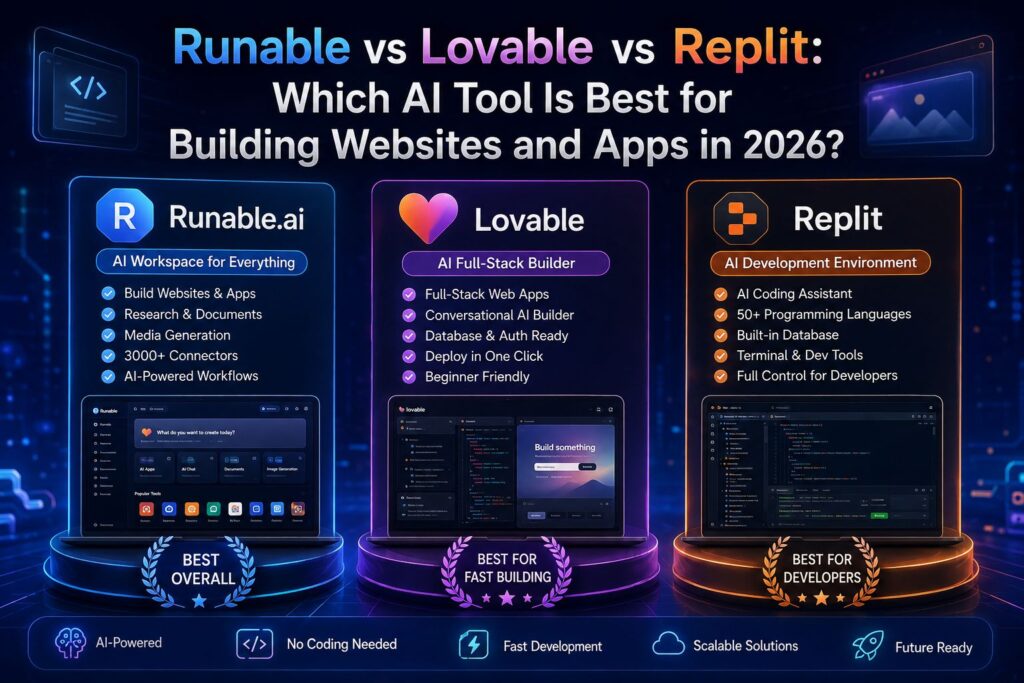
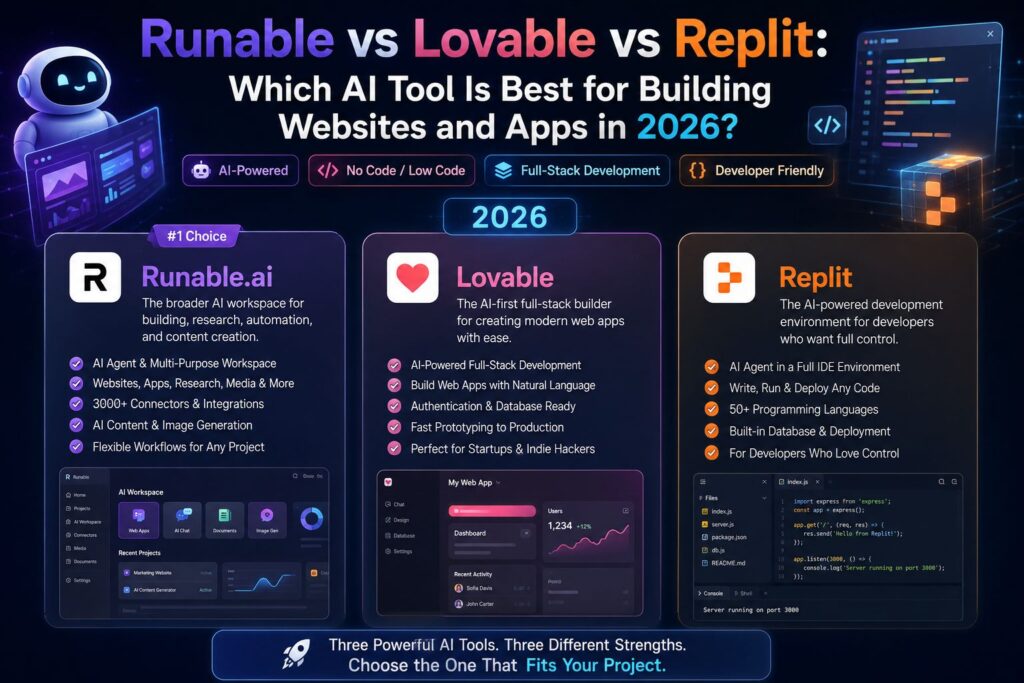
Runable takes a broader agent-based approach that combines website and app building with other AI workflows, connectors, research, content, media creation, and automation. Lovable focuses heavily on turning natural-language instructions into full-stack web applications. Replit combines AI agents with a traditional development environment, giving users access to code, files, a terminal, databases, and deployment.
In this guide, we compare Runable vs Lovable vs Replit across website creation, web apps, SaaS development, AI coding, ease of use, flexibility, pricing, and real-world use cases.
Want a deeper look at Runable’s features, pricing, strengths, and limitations? Check out our complete Runable Review 2026 before deciding whether it’s the right AI platform for you.
Runable vs Lovable vs Replit: Quick Comparison
| Feature | Runable | Lovable | Replit |
|---|---|---|---|
| Main approach | AI agent and multi-purpose workspace | AI-first app builder | AI development environment + IDE |
| Website creation | Excellent | Excellent | Excellent |
| Web app development | Strong | Excellent | Excellent |
| SaaS projects | Strong | Excellent | Excellent |
| Natural-language building | Yes | Yes | Yes |
| Database support | Available on supported plans/workflows | Built around full-stack workflows | Built-in database support |
| Authentication | Supported through app-building workflows | Strong full-stack support | Supported |
| Coding control | AI-first | More guided | Very strong |
| Traditional IDE | Not the main focus | Not the main focus | Yes |
| Multiple programming languages | Less developer-centric | Opinionated web stack | 50+ languages |
| Connectors/integrations | 3,000+ connectors | Strong integrations | Broad developer ecosystem |
| Media generation | Yes | Primarily software-focused | Primarily software-focused |
| Best for | AI-powered creation and broad workflows | Fast full-stack web apps | Developers wanting control |
| Free option | Yes | Yes | Yes |
Runable currently advertises websites and app building alongside slides, image and video creation, document/research workflows, multimodal chat, and more than 3,000 connectors. Its current pricing page lists a Free tier, Pro at $20/month, and Max at $100/month.
Lovable describes itself as an AI software engineer that lets users build websites and web applications through conversation. Its current system uses credits across building, Cloud, and AI functionality.
Replit takes a different approach. Its platform combines AI-assisted development with a full integrated development environment, terminal, file editing, database capabilities, deployment, and support for many programming languages. Its current pricing page lists a free Starter tier, Core at $25/month or $20/month when billed annually, and Pro at $100/month or $95/month annually.
We tested Runable’s AI-powered tools to see how well it handles website building, apps, content, research and creative workflows. Here’s what you should know before choosing a plan.
What Is Runable?
Runable is an AI-first platform designed to handle more than conventional software development.
Its current product positioning combines website and app building with AI-generated slides, images, videos, documents, research, connectors, and other workflows. Runable’s own documentation describes an agent workflow where users explain what they want in natural language, the agent works in a live environment, and the user can refine the result through conversation.
This broader approach is one of Runable’s biggest differences.
A user might start with a website, continue by researching competitors, generate marketing assets, connect an external service, and then return to the application—all within a broader AI workspace.
Runable also advertises more than 3,000 connectors, which can be important for projects that depend on external services. Its Pro and Max plans currently include website and app building, databases, analytics, Stripe integration, a free subdomain, and Android/iOS app building.
Learn how to build a professional website with Runable in 2026. This beginner-friendly guide walks you through the complete process, from getting started to creating and launching your website.
Who Should Use Runable?
Runable is particularly interesting for:
- Entrepreneurs building an MVP
- Non-developers who want to create software
- Website owners
- AI-focused creators
- Agencies
- Marketers who need both software and content
- People who want one AI workspace for multiple types of work
Its biggest advantage is breadth. Instead of being only a coding environment, Runable attempts to become an AI workspace capable of handling different parts of a digital project.
What Is Lovable?
Lovable is focused more directly on software creation.
Its central concept is simple: describe what you want in natural language and let the AI help build it.
Lovable’s current platform supports web applications and full-stack development workflows. Its official documentation describes a stack involving React, TypeScript, Tailwind, and Supabase, with capabilities such as authentication, databases, file storage, real-time functionality, Edge Functions, and Stripe integration.
This opinionated approach can be a major advantage.
Instead of giving users hundreds of technical decisions at the beginning, Lovable provides a relatively structured path from idea to working application.
For example, a founder could describe a dashboard containing user authentication, a database, subscription payments, and an admin area. Lovable can then help generate the application and iterate on it through conversation.
Lovable also allows users to own the projects and code they create, subject to third-party rights involving underlying AI models.
Who Should Use Lovable?
Lovable is particularly suitable for:
- Startup founders
- Product managers
- Designers
- Non-technical entrepreneurs
- Developers who want rapid prototyping
- Teams building web-based SaaS products
- Users who prefer an opinionated full-stack workflow
If your main objective is “I have an application idea and want to turn it into a working web app quickly,” Lovable is one of the strongest choices in this category.
What Is Replit?
Replit is fundamentally different from both Runable and Lovable because it combines AI development with a traditional coding environment.
Replit’s AI Agent can create applications from natural-language instructions, while the underlying platform gives users access to an IDE, files, terminal, databases, version-control integrations, and deployment.
That makes Replit particularly attractive to developers who do not want to give up direct control of the code.
Replit’s current platform supports more than 50 programming languages, and its AI Agent can handle tasks such as application generation, authentication, database work, and deployment.
Its current pricing page also highlights built-in databases, deployment options, collaboration, parallel agents, and access to more powerful models on higher tiers.
Who Should Use Replit?
Replit is a strong choice for:
- Developers
- Computer science students
- Technical founders
- Teams that need direct code access
- Backend-heavy projects
- Multi-language projects
- Developers who want an AI agent inside an IDE
If Runable emphasizes breadth and Lovable emphasizes guided full-stack creation, Replit emphasizes developer control plus AI assistance.
Runable vs Lovable vs Replit: Ease of Use
For beginners, the most important question is not which platform has the most features. It is which platform makes those features understandable.
All three allow users to communicate with AI using natural language, but their experiences differ.
Runable
Runable is designed to make AI useful across many types of work. Its agent can work on websites and applications while also handling other AI tasks.
This makes it attractive to users who want a general-purpose AI workspace rather than a dedicated coding product.
Lovable
Lovable is highly approachable for users who primarily want to build websites and web applications.
Its conversational workflow reduces the amount of technical setup required at the beginning. The platform’s opinionated stack can also reduce decision fatigue.
Replit
Replit can be beginner-friendly because its Agent can build applications from prompts, but the platform exposes significantly more developer-oriented functionality.
That can be a benefit or a disadvantage.
A beginner may appreciate the automation, while a developer may appreciate the ability to inspect files, open a terminal, modify code, and troubleshoot problems directly.
Winner for beginners
Lovable is arguably the easiest choice for someone whose main objective is building a full-stack web application without wanting to manage a traditional development environment.
However, Runable can be more attractive if the user wants software development plus research, content, media, connectors, and other AI workflows.
Replit becomes more attractive as the user’s technical requirements increase.
If you want an AI-powered platform for building websites and apps, you can try Runable and explore what it can do for your own project.
Building Websites With Runable, Lovable, and Replit
All three platforms can be used to create websites, but the ideal choice depends on the type of website.
Business Websites
For a normal business website with:
- Homepage
- About page
- Services
- Contact form
- Blog
- Responsive design
all three can be viable.
Runable has an advantage for users who also want to generate supporting content and media from the same AI environment.
Lovable is attractive for users who want a polished web experience generated through conversation.
Replit is useful when the website is part of a larger software project and needs substantial custom coding.
Landing Pages
For a simple marketing landing page, Lovable and Runable can both be strong choices.
Replit can also handle the job, but its deeper development environment may be unnecessary for a simple page.
Interactive Websites
Once a website becomes an application—with accounts, dashboards, databases, APIs, and payments—the differences become more important.
This is where Lovable and Replit become particularly strong competitors.
Building Web Apps and SaaS Products
SaaS development is where these platforms become much more interesting.
A real SaaS product may need:
- User registration
- Authentication
- Database
- User dashboard
- Admin panel
- Subscription payments
- Email notifications
- API integrations
- File storage
- Analytics
- Security
- Deployment
Lovable’s full-stack approach makes it particularly attractive for this type of project. Its documented stack includes React, TypeScript, Tailwind, Supabase, authentication, storage, Edge Functions, and Stripe integration.
Replit provides more underlying development flexibility. It can execute real server-side code, support multiple languages, and provide a more traditional development environment.
Runable is interesting when the SaaS project is part of a larger AI workflow involving integrations, research, automation, content, or other outputs.
Best for SaaS
There is no universal winner.
Lovable is excellent for a guided full-stack web SaaS workflow.
Replit is excellent when developers need more control over the runtime and code.
Runable becomes compelling when software development is only one part of a broader AI-powered business workflow.
AI Coding and Development Workflow
The three platforms also differ in how much control they give the user.
Runable: Agent-first
Runable’s workflow is centered around an AI agent that can execute tasks rather than simply provide code snippets.
Its documentation describes Agent, Chat, and Plan modes, with Plan Mode intended for more complex work involving authentication, payments, databases, or multiple integrations.
That is useful when you want the AI to handle a sequence of development tasks.
Lovable: Conversation-first
Lovable emphasizes describing the application in natural language and iterating from there.
Its credit system also reflects the complexity of individual actions. For example, its current pricing documentation shows different credit costs for tasks such as changing a button, removing a footer, adding authentication, or creating a landing page.
This makes Lovable particularly suited to iterative application building.
Replit: AI + IDE
Replit gives users an AI agent while maintaining a traditional development environment.
This is important because AI-generated code is not always perfect.
When something breaks, developers may need to:
- Inspect a file
- Read an error message
- Run a command
- Check a database
- Modify code manually
- Test the application
- Roll back changes
Replit’s IDE-oriented approach makes this workflow more natural.
A Practical Test: Give All Three the Same Project
The fairest way to compare AI development platforms is not to count marketing features.
It is to give them the same project.
For example, imagine the following prompt:
Build a responsive membership website with registration, login, user dashboard, referral links, membership packages, wallet balance, transactions, team tracking, admin controls, database integration, and a modern responsive interface.
Then evaluate each platform using the same criteria.
1. Initial generation:- How much of the requested application is created after the first prompt?
2. Design:- Is the interface modern, responsive, and consistent?
3. Functionality:- Do login, registration, dashboards, forms, and other features actually work?
4. Database:- Is the database correctly structured and connected?
5. Authentication:- Can users register, log in, log out, and maintain secure sessions?
6. Iteration:- How easily can the AI make changes without breaking existing functionality?
7. Debugging:- How well does the platform handle errors?
8. Deployment:- How easy is it to publish the finished application?
8. Code control:- Can an experienced developer take over and modify the project?
10. Cost:- How quickly does the project consume credits or paid usage?
This methodology is more useful than simply declaring that one platform is “the fastest.”
Pricing: Runable vs Lovable vs Replit
Pricing is particularly important for AI development platforms because usage-based credits can become a major part of the total cost.
Runable Pricing
Runable currently lists:
- Free: $0
- Pro: $20/month
- Max: $100/month
The Free plan currently advertises 1,500 daily credits, while Pro includes 25,000 monthly credits plus 1,500 daily credits and Max includes 150,000 monthly credits plus 1,500 daily credits.
Runable also includes capabilities beyond software development, including media generation, research, slides, connectors, and multimodal AI.
Lovable Pricing
Lovable has a Free plan and paid plans based around credits.
Its current pricing documentation says free users receive a daily grant of five build credits, up to 30 per month, along with Cloud and AI credits. Paid users receive additional credits through their subscription.
Lovable also updated its billing system in 2026 to make building, Cloud, and AI usage easier to track through a unified credit system.
Replit Pricing
Replit currently lists:
- Starter: Free
- Core: $25/month, or $20/month billed annually
- Pro: $100/month, or $95/month billed annually
The plans include different levels of monthly credits, collaboration, agent usage, deployment, and database functionality.
Important Pricing Warning
Do not compare these platforms only by the headline monthly price.
The real cost depends on:
- How complex your prompts are
- How often you ask the AI to make changes
- How much debugging is required
- Whether you need hosting
- Whether your application uses additional cloud services
- How credits are consumed
- Whether your project requires high-end models
For serious projects, always check the current pricing page before subscribing.
Which Is Best for Beginners?
If you have little or no coding experience, your priorities should be:
- Simple prompting
- Easy visual iteration
- Minimal setup
- Easy deployment
- Helpful error handling
- Clear project structure
Lovable is one of the strongest options for this group because its product is centered around conversational application building.
Runable is a strong alternative for users who want a broader AI assistant capable of handling websites, apps, content, research, media, and integrations.
Replit is better if you want to gradually move from AI-assisted building into actual programming.
Which Is Best for Developers?
For developers, the priorities change.
You may care more about:
- Code access
- Terminal access
- Multiple languages
- Backend flexibility
- Git integration
- Debugging
- Infrastructure
- Runtime control
This is where Replit has a significant advantage.
Its full development environment gives experienced users a more traditional workflow while allowing AI to automate large portions of the work.
Lovable is still useful for rapid web application development, while Runable is compelling for developers who want an AI agent that can work across broader workflows.
Which Is Best for Startups?
Startups should think about speed and long-term maintainability together.
A platform that creates an impressive prototype in one hour is not necessarily the best platform for a production SaaS application.
For an early MVP:
Lovable can be excellent because it provides a guided route from idea to full-stack web application.
For a technical startup:
Replit may be preferable because developers have deeper control over the environment.
For a startup where software, content, research, automation, and marketing all need to work together:
Runable can be particularly interesting.
Which Is Best for Website Creation?
For basic websites, all three can work.
Choose Runable if:
You want website creation combined with content, images, videos, research, integrations, and other AI workflows.
Choose Lovable if:
Your primary goal is creating a polished interactive website or web application through natural-language instructions.
Choose Replit if:
Your website is closely connected to a custom software backend or you want full developer control.
The Biggest Limitation of AI App Builders
AI app builders are powerful, but they do not eliminate the need for human review.
An AI can generate an application that looks finished while still containing problems.
These may include:
- Authentication vulnerabilities
- Incorrect database permissions
- Poor error handling
- Broken edge cases
- Weak validation
- Performance problems
- Accessibility issues
- SEO problems
- Incorrect business logic
- Security vulnerabilities
That is why “AI built my app” should not automatically mean “my app is production-ready.”
For simple prototypes, the difference may not matter much.
For applications handling payments, personal information, financial transactions, or complex business logic, professional testing and security review remain essential.
Runable vs Lovable vs Replit: Final Verdict
There is no single winner for every user.
The three platforms are becoming increasingly capable, but they approach AI development from different directions.
Best for broad AI-powered workflows: Runable
Runable stands out because it goes beyond application development.
Its platform combines websites and apps with research, documents, slides, images, videos, connectors, and other AI capabilities. That makes it particularly attractive for entrepreneurs, creators, agencies, and users who want one AI workspace for multiple types of work.
Best for guided full-stack web applications: Lovable
Lovable is a strong choice when the primary goal is turning an idea into a working web application through natural language.
Its opinionated full-stack approach can reduce technical complexity and make it easier for non-developers to get started.
Best for developer control: Replit
Replit is the strongest choice for developers who want AI assistance without giving up their development environment.
Its combination of AI agents, IDE functionality, terminal access, databases, deployment, and multi-language support makes it particularly powerful for technical users.
So, Which One Should You Choose?
Choose Runable if you want an AI workspace that can handle software plus other digital tasks.
Choose Lovable if your main goal is to quickly create and iterate on a full-stack web application without managing a traditional development environment.
Choose Replit if you are a developer—or want to become one—and need direct control over code, runtime, files, and backend infrastructure.
For beginners, Lovable is arguably the easiest starting point.
For developers, Replit offers the deepest traditional development workflow.
For creators and entrepreneurs who want broader AI capabilities beyond coding, Runable is one of the most interesting options to consider.
The real winner, therefore, is not the platform with the longest feature list. It is the platform that best matches the way you actually want to build.
Frequently Asked Questions
Here are answers to some of the most common questions about Runable, Lovable, and Replit.
Is Runable better than Lovable?
It depends on the project. Runable has a broader AI workspace that includes websites and apps alongside research, media, documents, and connectors. Lovable is more focused on conversational full-stack web application development. Choose Runable for broader workflows and Lovable when application building is your primary objective.
Is Runable better than Replit?
Runable can be better for users who want AI-assisted software creation combined with other workflows. Replit is generally more attractive to developers who want a traditional coding environment, terminal access, multiple programming languages, and greater control over the development process.
Is Lovable better for beginners?
Lovable is one of the strongest options for beginners who want to create web applications without starting with a traditional coding environment. However, beginners should still learn enough HTML, CSS, JavaScript, databases, and security concepts to understand and test what the AI creates.
Is Replit good for building full-stack applications?
Yes. Replit's AI Agent and development environment support full-stack application workflows, while the platform provides databases, deployment, code editing, and a broader runtime environment. It is especially useful for developers who need more control over their application's backend and infrastructure.
Which AI tool is best for building a SaaS?
There is no universal answer. Lovable is excellent for guided full-stack SaaS development, Replit is strong for technical teams that need deeper control, and Runable is attractive when SaaS development needs to be combined with broader AI workflows and integrations.
Can AI app builders replace developers?
Not completely. They can automate substantial parts of development, especially prototypes, repetitive coding, UI generation, integrations, and debugging. However, complex applications still require human oversight for architecture, security, testing, performance, business logic, and long-term maintenance.
Which AI website builder is best in 2026?
The best choice depends on the website. Runable is compelling for websites combined with broader AI workflows, Lovable is strong for interactive web applications, and Replit is particularly useful when a website is part of a larger custom software project.
Should I learn coding if I use an AI app builder?
Yes. You do not need to become an expert before using these tools, but basic coding knowledge becomes increasingly valuable as your project grows. Understanding code helps you evaluate AI output, diagnose errors, improve performance, protect user data, and maintain the application after launch.
Ready to Build Your Next Website or App?
Turn your idea into a working website or app with Runable's AI-powered development tools.
Try Runable Free → Affiliate link · No extra cost to youFinal Takeaway
Runable, Lovable, and Replit represent three different directions for AI-powered software development.
Runable is the broader AI workspace. Lovable is the guided full-stack builder. Replit is the AI-powered development environment.
Instead of asking which platform is universally best, start with your project.
Runable
Broader AI WorkspaceIf you want software development combined with research, content, media generation, connectors, and other AI-powered workflows, Runable deserves serious consideration.
Lovable
Guided Full-Stack BuilderIf you want to build quickly without worrying about traditional development infrastructure, Lovable is a strong option for creating full-stack web applications with AI assistance.
Replit
AI Development EnvironmentIf you want AI assistance while retaining deep control over code and the development environment, Replit is a strong choice for developers who want flexibility and control.
Most importantly, test the platforms with the same real project before committing to one. A feature checklist can tell you what a platform claims to support. A real project tells you how well it actually fits your workflow.