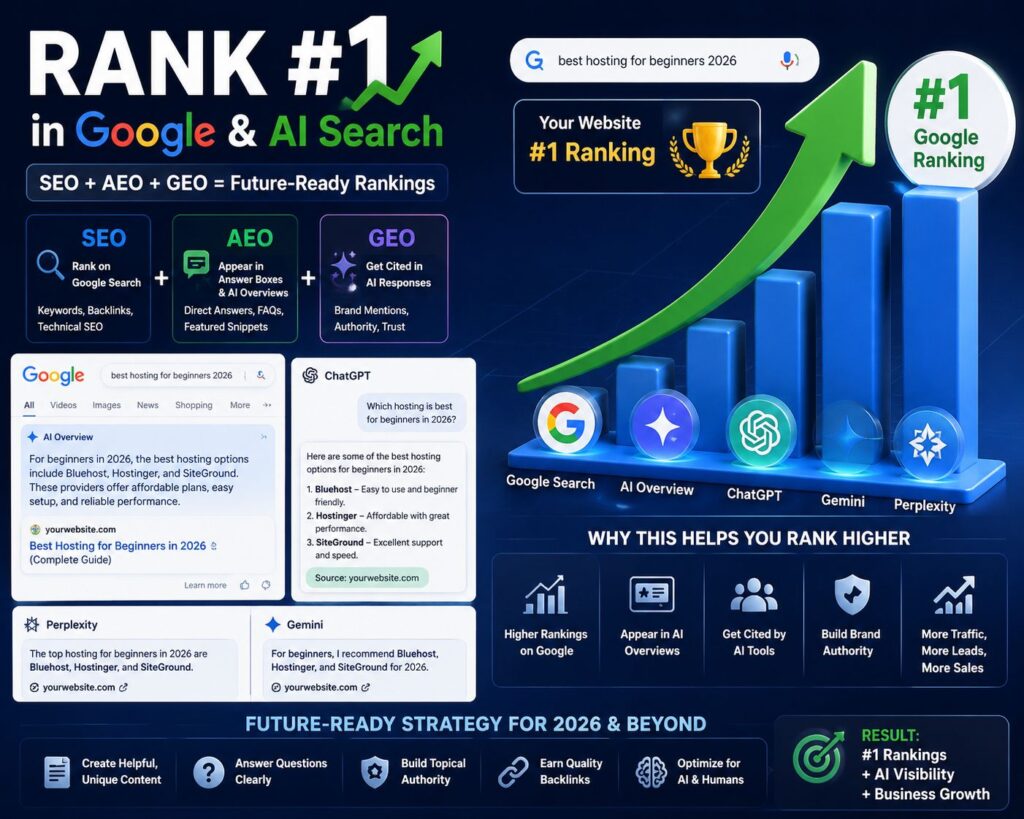
Google Says AEO & GEO Are Still SEO: Complete Guide for Marketers (2026)
Discover why Google says AEO and GEO are simply part of modern SEO. Learn practical strategies to improve visibility in Google Search, AI Overviews, ChatGPT, Gemini, Perplexity, and other AI-powered search engines.
Google AI
AI Overviews
SEO
Organic Rankings
GEO
AI Visibility
AEO
Answer Engines
The SEO industry changes fast, but 2026 is bringing one of the biggest shifts yet. With the rise of AI-powered search experiences, AEO vs GEO vs SEO has become one of the most discussed topics among digital marketers, bloggers, and businesses. Marketers are hearing new terms everywhere, including AEO, GEO, AI Search Optimization, and answer engines.
Many people started believing that traditional SEO was dying and that AI search would completely replace it. But according to Google’s latest AI Search guidance, AEO vs GEO vs SEO is not about replacing traditional optimization. Instead, Google explains that these strategies are still part of modern SEO.
That statement matters because businesses, bloggers, agencies, and marketers are trying to understand how AI search works and how websites can stay visible in search results. The good news is that most of the core SEO fundamentals still matter. Helpful content, authority, structure, trust, and user intent remain essential for online visibility.
At the same time, search engines are evolving rapidly. Instead of showing only traditional blue links, AI-powered platforms now generate direct answers, summaries, and conversational responses for users. This shift is changing how content appears online and why AEO vs GEO vs SEO is becoming increasingly important for marketers in 2026.
Today, businesses must optimize content not only for rankings but also for AI-generated answers and recommendation systems. That is where AEO vs GEO vs SEO enters the conversation in a much bigger way. AEO focuses on answer engine optimization, GEO helps improve generative engine visibility, and SEO continues to build the foundation for search performance.
In this article, we will explain what AEO vs GEO vs SEO means, why Google says these strategies are still SEO, and what marketers should focus on to stay visible in the AI-driven search landscape of 2026.
According to Google Search Central, creating helpful and people-first content remains essential for long-term search visibility.
Read the complete analysis:
Google Launches Core Update Amid I/O AI Search Overhaul
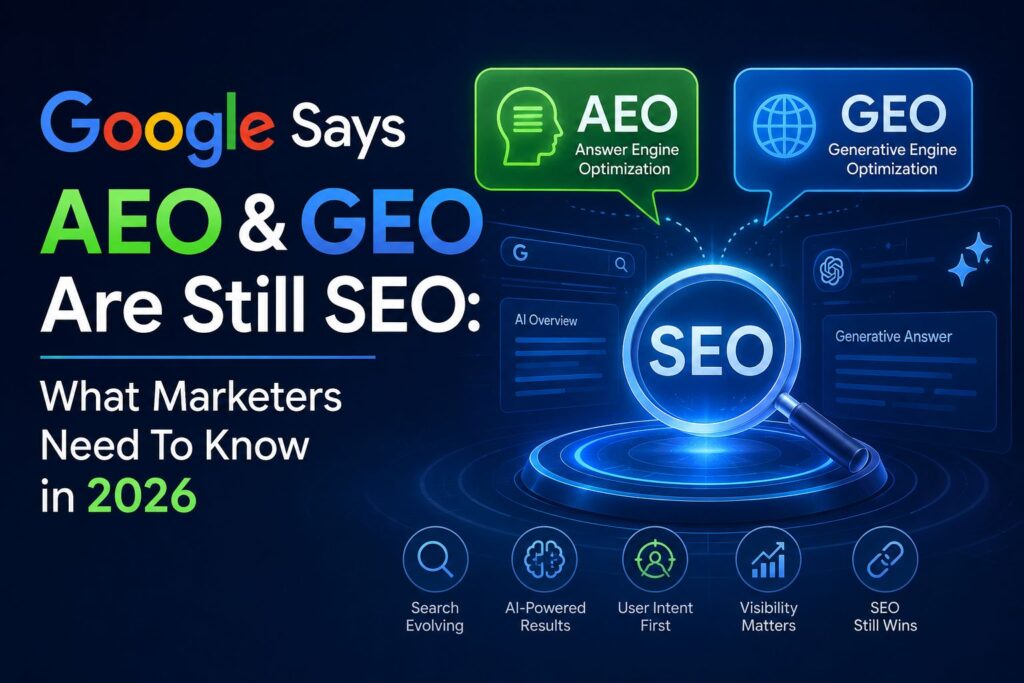
What Is AEO?
AEO stands for Answer Engine Optimization. In the discussion around AEO vs GEO vs SEO, AEO focuses on optimizing content so search engines and AI assistants can easily extract accurate answers from your website.
Instead of only trying to rank for keywords, AEO helps search systems understand your content more clearly and deliver direct responses to users. This is one of the biggest differences highlighted in AEO vs GEO vs SEO strategies for modern AI-powered search.
With AI search becoming more advanced in 2026, businesses now need content that is structured, trustworthy, and easy for answer engines to process. That is why AEO vs GEO vs SEO is becoming an important part of every modern digital marketing strategy.
As digital marketing continues to evolve alongside AI search, businesses now require a more holistic marketing strategy. Gone are the days when companies relied solely on social media, search engine marketing, or email campaigns. Today, many organizations look for a digital marketing agency that can deliver an integrated approach, combining strategic planning, content creation, SEO, AEO, GEO, and cross-channel execution. Managing these interconnected marketing activities efficiently has become one of the biggest challenges for modern teams, making structured workflows and agile collaboration more important than ever.
- What your content means
- What question it answers
- How useful it is
- Whether it can be trusted
- AEO vs GEO vs SEO
AEO is becoming more important because people now use:
- Google AI Overviews
- ChatGPT
- Gemini
- Perplexity
- Voice assistants
- AI search tools
- AEO vs GEO vs SEO
These systems prefer content that is:
- Clear
- Structured
- Accurate
- Easy to summarize
For example, if someone searches:
“What is GEO in SEO?”
Google may generate an AI answer instead of only showing traditional links.
If your article explains the topic clearly, your content has a higher chance of being included in AI-generated summaries.
That is AEO in action.
To better understand modern AI discoverability, read our guide on The 3 Layers of AI Visibility Every Brand Must Understand.
What Is GEO?
GEO stands for Generative Engine Optimization.
This term focuses on optimizing content for generative AI systems.
Unlike traditional search engines that mainly rank pages, generative engines create answers using information from multiple sources AEO vs GEO vs SEO.
GEO aims to improve your chances of being referenced or cited in those AI-generated responses.
This includes platforms like:
- Google AI Search
- ChatGPT
- Gemini
- Claude
- Perplexity AI
GEO strategies often include:
- Writing expert-level content
- Adding original insights
- Using clear formatting
- Improving topical authority
- Creating trustworthy content
- Building strong brand mentions
Many marketers think GEO is completely different from SEO.
But Google disagrees.
Building authority through niche backlinks is still important, and our AI Guest Post Sites List can help marketers find relevant opportunities.
Why Google Says AEO & GEO Are Still SEO
Google considers Answer Engine Optimization (AEO) and Generative Engine Optimization (GEO) to be extensions of traditional SEO rather than completely separate strategies. AI-powered search AEO vs GEO vs SEO features, including AI Overviews and generative search experiences, still depend on Google’s core systems for crawling, indexing, and ranking web pages. In simple terms, there is no separate “AI index.” Websites that publish high-quality, relevant, and well-optimized content are more likely to gain visibility both in traditional search results and AI-generated answers.
Google’s Google AI Overview Documentation explains how AI-generated answers rely on high-quality and trustworthy web content.
The fundamentals still remain the same:
- Helpful content
- User-focused information
- AEO vs GEO vs SEO
- Strong site structure
- Technical optimization
- Authority and trust
- High-quality pages
In other words, if your website already follows strong SEO practices, you are already building a foundation for AEO and GEO.
The biggest difference is how information is delivered.
Traditional SEO focused heavily on rankings and clicks.
Modern AI search optimization focuses on:
- Visibility in AI summaries
- Being cited in AI answers
- Building topical authority
- Creating content AI systems can understand easily
- AEO vs GEO vs SEO
This means marketers should stop treating AEO vs GEO vs SEO as completely separate strategies.
They now work together.
Recent reports from Search Engine Journal show that AI search optimization is becoming a major focus for digital marketers in 2026.
How AI Search Is Changing SEO in 2026
By 2026, online visibility will no longer depend only on ranking using propelly AEO vs GEO vs SEO at the top of search results. Instead, brands will need to focus on being mentioned and trusted within AI-generated responses from platforms like OpenAI ChatGPT and Perplexity AI. As AI-driven search continues to evolve, businesses must treat AI SEO as a core part of their digital infrastructure rather than just an extension of traditional optimization. Companies that build authority, trust, and high-quality content will have a stronger chance of appearing in AI-powered answers and recommendations.
Search is becoming more conversational.
Instead of typing short keywords, users now ask detailed questions like:
- What is the best AI SEO strategy for small businesses?
- How does GEO work in AI search?
- Can AI replace traditional SEO?
AI search systems analyze intent more deeply than before.
This means keyword stuffing and low-quality content are becoming less effective.
In 2026, successful SEO will depend more on:
1. Topical Authority
Search engines trust websites that consistently publish high-quality content around a specific niche.
If your site covers AI marketing, SEO, and digital trends regularly, your authority increases.
2. Content Clarity
AI systems prefer content that is:
- Easy to read
- Well-structured
- Organized with headings
- Direct and informative
- AEO vs GEO vs SEO
Complex or confusing writing reduces the chances of being used in AI-generated answers.
3. E-E-A-T Signals
Experience, Expertise, Authoritativeness, and Trustworthiness remain extremely important.
Google wants reliable information.
That means marketers should focus on:
- Original insights
- Real examples
- Expert analysis
- Credible sources
- AEO vs GEO vs SEO
4. User Intent Optimization
Modern SEO is less about exact-match keywords and more about solving user problems better perform these AEO vs GEO vs SEO.
Your content should answer:
- What users want
- Why they searched
- What action they need next
5. Structured Formatting
AI systems understand content better when pages include:
- Headings
- Bullet points
- FAQs
- Tables
- Clear sections
This improves readability for both users and AI systems.
Strong AI visibility also depends on quality data, as explained in Why Your AI Ad Strategy Is Only As Good As Your Data.
Does Traditional SEO Still Matter?
Traditional SEO still plays a critical role in digital marketing, even as AI-powered search experiences continue to grow. In the world of AEO vs GEO vs SEO, platforms like ChatGPT and Google Gemini are changing how users discover information, but strong SEO practices still matter. Technical optimization, quality content, website authority, and user experience help search engines understand and rank your site.
Simply put, AEO vs GEO vs SEO shows that traditional SEO helps your website get discovered, while AI optimization improves the chances of your content appearing in AI-generated answers. Businesses that understand AEO vs GEO vs SEO will have stronger visibility in the future of search.
Despite all the hype around AI search, traditional SEO still matters in 2026.
Google still relies heavily on:
- Crawling
- Indexing
- Site speed
- Internal linking
- Mobile usability
- Backlinks
- Content quality
Without these basics, your chances of visibility decrease significantly.
AI search is not replacing SEO.
It is evolving it.
That is why Google says AEO and GEO are still SEO (AEO vs GEO vs SEO).
The foundation remains the same.
The presentation layer is simply becoming smarter.
Experts at the Ahrefs Blog emphasize that authority and relevance still play a major role in modern SEO.
Practical SEO Tips for AI Search in 2026
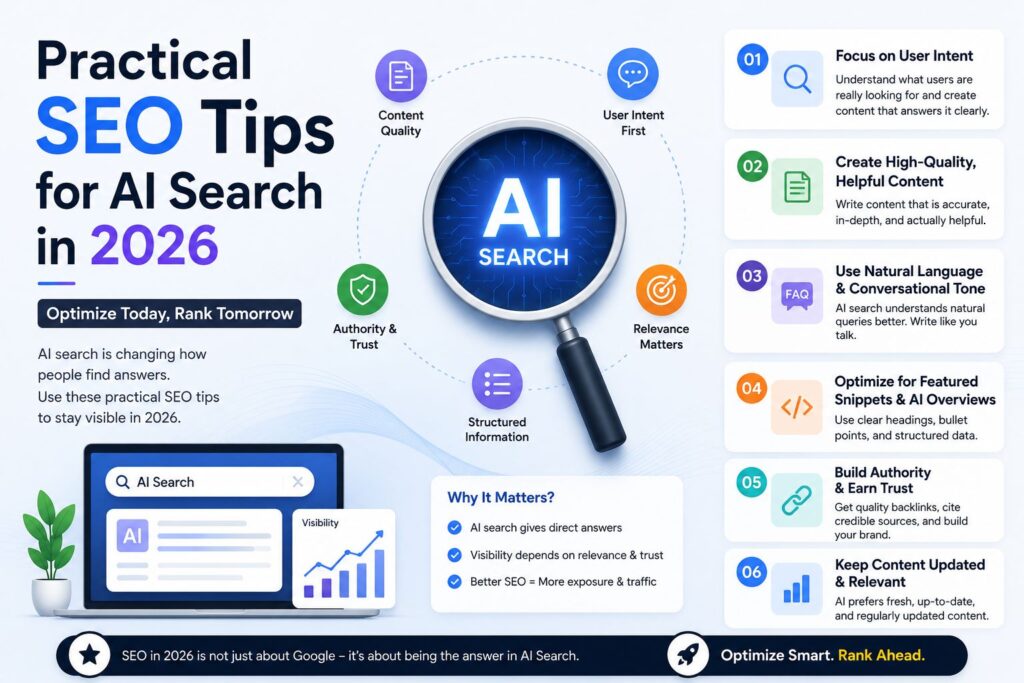
If you want your content to perform better in AI search environments, focus on these strategies.
Create Question-Based Content
Answer real user questions directly.
Examples:
- What is AEO?
- What is GEO?
- Is SEO still relevant in 2026?
- AEO vs GEO vs SEO
Question-based content performs well in AI-generated answers.
Use Simple Language
Avoid unnecessary complexity.
AI systems prefer content that is:
- Clear
- Direct
- Easy to summarize
Simple writing also improves user engagement.
Build Topical Clusters
Instead of publishing random articles, create connected content around one topic.
For example:
- AI SEO
- AI visibility
- GEO
- AEO
- AI search trends
- Google AI updates
This improves topical authority.
Improve Internal Linking
Internal links help search engines understand your site structure.
They also increase crawl efficiency and user engagement.
Link related articles naturally inside your content.
Add FAQs
FAQ sections improve visibility for conversational search queries.
They also increase the chances of appearing in featured snippets and AI summaries.
Focus on Original Value
AI-generated generic content is becoming common.
To stand out, marketers must add:
- Real insights
- Unique opinions
- Case studies
- Data
- Personal experience
Originality is becoming a major ranking advantage.
Common Mistakes Marketers Should Avoid
Many marketers misunderstand AI search optimization.
Here are some common mistakes:
Treating GEO As a Separate Industry
GEO is not replacing SEO.
It builds on SEO principles.
Ignoring Technical SEO
Even the best content struggles if:
- Pages load slowly
- Sites are poorly structured
- Mobile experience is weak
Technical SEO still matters.
Overusing AI Content
Publishing low-quality AI-generated articles without editing can damage trust and rankings.
Human oversight remains important.
Chasing Every Trend
Many marketers jump between new buzzwords without building strong fundamentals.
Focus first on:
- Helpful content
- User intent
- Authority
- Consistency
AI Search Optimization (AEO) in 2026
The way people search online has changed dramatically. Users now ask complete, conversational questions instead of typing short keywords. As AI-generated answers continue to dominate search results, many users find the information they need without clicking through to a website. This makes visibility across multiple AI platforms more valuable than ever. Businesses must optimise their content not only for Google Search but also for AI-driven tools such as ChatGPT, Perplexity, and trusted community platforms like Reddit.
According to the AI Search Study by AIToolMind, AI-powered search is changing how users discover and interact with online content.
AI Search Optimization Best Practices
To increase the chances of being cited by AI systems, place clear and direct answers at the beginning of each section. Organise your content with logical headings, short paragraphs, and structured data such as Schema.org markup. Strong E-E-A-T (Experience, Expertise, Authoritativeness, and Trustworthiness) remains essential, supported by high-quality content, credible backlinks, consistent brand mentions, and genuine customer reviews. AI models rely on these trust signals when deciding which sources to reference.
Measuring AI Search Performance
Traditional SEO metrics are no longer enough. Businesses should monitor how often their brand appears in AI-generated responses and whether those citations are accurate. It’s also important to track referral traffic from AI chat platforms and other conversational search tools, as these channels are becoming an increasingly valuable source of visitors. By combining AI citation tracking with conventional SEO analytics, you can gain a clearer understanding of your brand’s visibility in the evolving search landscape.
Pro Tip: In 2026, success in AI search isn’t just about ranking higher—it’s about creating reliable, well-structured content that AI platforms trust enough to cite as the best answer.
Common GEO Mistakes to Avoid
Generative Engine Optimization (GEO) is about more than publishing content—it’s about creating information that AI search engines can trust, understand, and reference. Even high-quality websites can struggle to appear in AI-generated answers if they make common optimization mistakes. Avoiding these issues will improve your visibility across AI platforms like ChatGPT, Google AI Overviews, and Perplexity while strengthening your overall SEO performance.
Keyword Stuffing
Overloading your content with the same keywords is an outdated SEO tactic that no longer works. Modern AI search engines focus on context, relevance, and natural language rather than keyword frequency. Write for people first, using related terms and conversational language that answers real user questions.
Thin AI-Generated Content
Publishing large amounts of generic AI-written content without human editing can damage your credibility. AI search systems favour content that demonstrates original insights, practical experience, and genuine expertise. Always review, fact-check, and enhance AI-generated drafts before publishing to ensure they provide real value.
Missing Author Information
Anonymous content often lacks the trust signals that AI platforms look for. Including an author name, professional biography, qualifications, and contact details helps establish credibility and supports Google’s E-E-A-T principles. Readers and AI systems are both more likely to trust content created by identifiable experts.
Outdated Statistics and Facts
AI search engines prefer accurate and up-to-date information. Old statistics, broken references, or outdated industry trends can reduce your content’s reliability. Regularly review your articles, update data with the latest research, and refresh examples so your content remains relevant and trustworthy.
Poor Internal Linking
Many websites overlook the importance of internal links, but they help both users and AI understand how your content is connected. Linking related articles, guides, and service pages creates a stronger content structure, improves navigation, and makes it easier for AI systems to discover and interpret your website.
Weak E-E-A-T Signals
Experience, Expertise, Authoritativeness, and Trustworthiness (E-E-A-T) are essential for long-term success in AI search. If your website lacks expert content, credible citations, customer reviews, case studies, or strong brand mentions, AI platforms may hesitate to recommend your pages. Building authority through high-quality content, reputable backlinks, and transparent business information increases your chances of being cited in AI-generated answers.
Key Takeaway: GEO success isn’t about publishing more content—it’s about publishing content that is accurate, well-structured, trustworthy, and genuinely helpful. By avoiding these common mistakes, you can improve your visibility across both traditional search engines and the growing ecosystem of AI-powered search platforms.
Want to build high-quality backlinks and improve AI search visibility? Read this detailed AI Guest Blogging for Startups guide for practical strategies and best practices.
Comparison Table
| Traditional SEO | Modern SEO (SEO + GEO + AEO) |
|---|---|
| Google Rankings | Google + AI Search Engines |
| Keywords | Entities & Context |
| Backlinks | Backlinks + Mentions + Citations |
| Click-Through Rate (CTR) | AI Visibility & Citations |
| Search Engine Results (SERP) | AI-Generated Answers |
The Future of SEO Is AI-Assisted, Not AI-Replaced
The future of SEO is not about replacing human strategy with AI.
Instead, it is about combining:
- Human expertise
- AI tools
- Search intent optimization
- Authority building
- Helpful content
Google’s latest guidance makes one thing very clear:
AEO and GEO are still SEO.
Marketers who understand this early will have a strong advantage in 2026.
Rather than abandoning SEO, businesses should adapt their existing strategies for AI-powered search environments.
The websites that focus on trust, clarity, expertise, and user value will continue to perform well — regardless of how search evolves.
o understand the future of trustworthy and secure AI systems, read this comprehensive guide on AI Agent Standards 2026:
Conclusion
AI search is changing how people discover information online, but the fundamentals of visibility are still deeply connected to SEO.
Google’s statement that AEO and GEO are “still SEO” confirms that marketers should focus on evolving their strategies instead of replacing them completely.
The future belongs to websites that combine traditional SEO best practices with AI-friendly content optimization.
That means creating clear, helpful, trustworthy, and structured content that both users and AI systems can understand easily.
In 2026, SEO is not disappearing.
It is simply becoming smarter.
According to insights shared on the Semrush Blog, optimizing for search intent is becoming more important than keyword stuffing.
FAQs
What is AEO in SEO?
AEO stands for Answer Engine Optimization. It focuses on optimizing content so AI systems and search engines can easily understand and deliver answers from your website.
What is GEO in digital marketing?
GEO means Generative Engine Optimization. It focuses on improving visibility inside AI-generated search responses from tools like ChatGPT, Gemini, and Google AI Search.
Does Google recommend AEO
Google doesn’t officially use the term AEO, but it recommends creating helpful, well-structured, and trustworthy content that also supports AI search visibility.
How do AI search engines choose sources?
AI search engines prefer content that is accurate, up-to-date, well-organised, and comes from trusted websites with strong E-E-A-T signals.
Is schema required for GEO?
No. Schema isn’t required, but it helps AI and search engines understand your content better, improving its chances of being cited.
Can ChatGPT cite my website?
Yes. If your website provides reliable, high-quality, and relevant content, it may be referenced in ChatGPT and other AI search tools.
Is GEO replacin
Mene complete SEO-optimized human-written article ready kar diya hai — including:
- 1500+ words
- SEO title
- Meta description
- Focus keywords
- Headings structure
- FAQs
- Internal & external link suggestions
- Featured image concept
- Alt text
- Social media caption
At AIToolMind, we regularly cover SEO, AI tools, and the future of digital visibility.