Why Your AI Ad Strategy Is Only As Good As Your Data
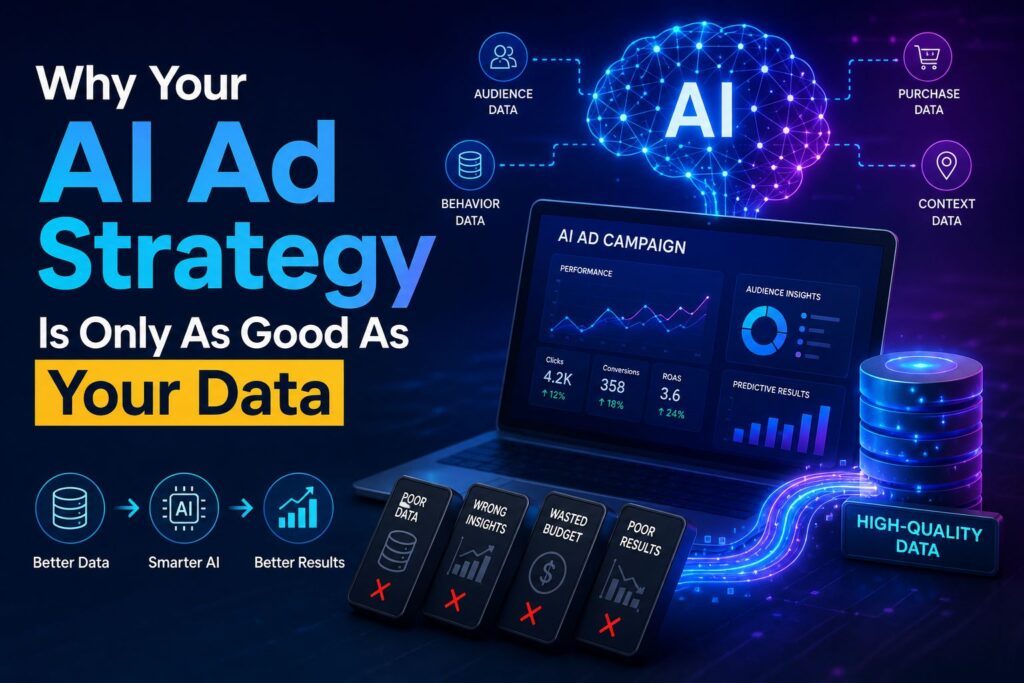
Artificial intelligence is changing digital advertising faster than most businesses expected. Platforms like Google Ads, Meta Ads, TikTok Ads, and LinkedIn Ads are now heavily powered by machine learning systems that automatically optimize targeting, bidding, placements, and creative performance. In 2026, building a successful AI ad strategy has become essential for brands that want to stay competitive in the digital advertising landscape.
Many marketers believe AI advertising tools can instantly improve campaign results with minimal effort. But there is one major problem most businesses ignore:
AI systems are only as effective as the data they receive.
If your business is feeding poor-quality data into AI advertising systems, your campaigns will likely produce weak targeting, low-quality leads, wasted ad spend, and inaccurate optimization decisions. This is why a modern AI ad strategy must focus not only on automation but also on accurate data collection, audience insights, and conversion tracking.
In 2026, successful AI advertising is no longer just about automation. It is about building a strong data foundation that helps AI systems make smarter decisions. Modern advertising platforms increasingly depend on first-party data, audience behavior, conversion tracking, and contextual signals to improve campaign performance. Businesses that invest in a long-term AI ad strategy are now seeing better targeting accuracy, improved ROI, and stronger customer engagement.
This shift is changing the future of digital marketing. Companies that fail to adapt their AI ad strategy to evolving AI-powered advertising systems may struggle to compete in an increasingly automated online marketplace. At the same time, brands that combine smart data practices with a scalable AI ad strategy can unlock more efficient advertising, better personalization, and sustainable business growth in the years ahead.
Understanding AI visibility is becoming essential for brands that want to improve their digital advertising performance.
According to Think with Google, data-driven marketing helps brands improve ad personalization and campaign performance.
The Rise of AI-Powered Advertising
AI has become the operational core of modern advertising systems. Google Performance Max, Meta Advantage+, AI ad strategy, automated bidding systems, predictive audiences, and AI-generated creative tools now control large portions of digital ad campaigns.
According to recent industry reports, AI-powered advertising AI ad strategy spending is growing rapidly because businesses want faster optimization, automated testing, and scalable personalization.
Platforms now use AI for:
- Audience targeting
- Bid adjustments
- Ad personalization
- Creative testing
- Predictive optimization
- AI ad srrategy
- Campaign automation
- Performance forecasting
This creates massive opportunities for marketers. However, it also creates a dangerous dependency on data quality.
Without reliable data, AI systems start making poor optimization decisions.
Why Data Is the Foundation of AI Advertising
Your updated description with the focus keyword “AI ad strategy” Artificial intelligence advertising systems learn from patterns. Every click, conversion, engagement signal, website interaction, purchase event, and audience behavior helps machine learning systems improve campaign performance. However, even the best AI ad strategy can fail when the data being used is inaccurate, incomplete, or poorly structured.
This is why many businesses experience:
- High ad costs
- Low conversion quality
- Weak ROAS
- Poor targeting
- Irrelevant audience reach
- AI ad srrategy
The problem is often not the advertising platform itself. The real issue is the data feeding the system. A successful AI ad strategy depends heavily on clean, accurate, and well-organized data that helps machine learning algorithms optimize campaigns effectively.
Researchers and marketers increasingly describe this as a “data-centric AI” challenge where data quality directly influences machine learning performance. Without reliable data, even an advanced AI ad strategy cannot deliver strong targeting, better conversions, or sustainable advertising growth.
In simple terms:
Bad data creates bad AI decisions.
Businesses that want long-term success must understand that a powerful AI ad strategy starts with high-quality data, accurate tracking, and meaningful audience insights.
Many experts share valuable digital marketing insights about AI-driven advertising strategies.
Common Data Problems That Hurt AI Campaigns
Many businesses unknowingly damage their own AI advertising performance because their tracking and audience data are weak.
Here are the most common issues.
1. Poor Conversion Tracking
If conversions are not tracked correctly, AI systems cannot learn which users are valuable.
For example:
- Missing purchase events
- Duplicate conversions
- Incorrect attribution
- Broken tracking pixels
- Server-side tracking errors
- AI ad srrategy
All of these problems reduce optimization accuracy.
AI bidding systems depend heavily on conversion quality signals. If the signals are wrong, optimization becomes unstable.
2. Weak First-Party Data
Third-party cookies are becoming less reliable because of privacy regulations and browser restrictions.
As a result, first-party data is becoming one of the most valuable assets in advertising.
First-party data includes:
- Customer emails
- CRM data
- Purchase history
- Website behavior
- Subscriber activity
- Customer preferences
Businesses with stronger first-party data often achieve better AI ad strategy and AI advertising performance because the algorithms receive higher-quality audience signals.
3. Poor Audience Segmentation
Many advertisers still use extremely broad targeting without understanding audience intent.
AI systems need structured audience information to identify:
- High-intent buyers
- Returning customers
- Engaged visitors
- Qualified leads
- Valuable customer segments
Without proper segmentation, campaigns become inefficient.
4. Inconsistent Campaign Data
Messy naming conventions, inconsistent tagging, and poor analytics organization confuse reporting systems.
Modern AI ad strategy AI systems rely on structured information to improve campaign learning.
Industry experts increasingly recommend:
- Taxonomy cleanup
- Consistent metadata
- Organized analytics systems
- Structured audience labeling
to improve AI campaign optimization.
Strong customer data strategies help brands improve personalization and campaign accuracy.
Why First-Party Data Matters More Than Ever
One of the biggest changes in advertising is the move away from third-party tracking toward first-party ecosystems.
This shift is transforming:
- Google Ads
- Meta Ads
- Retail media networks
- Programmatic advertising
- AI-driven personalization
Modern advertising systems increasingly prioritize businesses with strong customer data infrastructure.
Brands using reliable first-party data often see:
- Better targeting accuracy
- Lower acquisition costs
- Higher conversion quality
- Improved personalization
- More stable performance
Some advertising studies report significantly higher return on ad spend when marketers use first-party data strategies combined with AI optimization systems.
Many businesses also use AI guest posting opportunities to improve brand authority and online reach.
Google and Meta Are Automating Advertising Faster
Google and Meta are aggressively pushing automation-focused advertising systems.
Google’s Performance Max campaigns now automate:
- Placements
- Creative combinations
- Bidding
- Audience expansion
- Budget optimization
Meta Advantage+ campaigns operate similarly using AI-driven optimization.
These platforms are reducing manual campaign control while increasing dependency on machine learning systems.
This creates a new challenge for marketers:
If automation increases, data quality becomes even more important.
Businesses can no longer rely only on manual optimization tactics.
Instead, they must improve:
- Tracking infrastructure
- Customer data collection
- Analytics quality
- Conversion reporting
- Audience intelligence
AI Advertising Without Strategy Is Dangerous
Many businesses assume AI can fully replace marketing strategy.
That assumption is becoming a major problem.
AI tools can automate processes, but they still need:
- Brand positioning
- Human creativity
- Emotional messaging
- Audience understanding
- Strategic direction
Recent industry discussions warn that AI-generated advertising is becoming repetitive and emotionally weak because too many brands rely entirely on automation without strong creative direction.
This is why some AI-generated ads fail despite advanced technology.
The issue is not the AI itself.
The issue is poor strategic input.
Proper Google Ads optimization can improve audience targeting and ad performance.
The Hidden Risk of AI Advertising
As AI systems become more advanced, concerns around data privacy, manipulation, and behavioral targeting are also increasing.
Studies now show that AI systems can infer highly detailed user characteristics based purely on ad exposure patterns and behavioral signals.
This raises important questions about:
- Consumer privacy
- Ethical targeting
- Transparency
- Data security
- AI manipulation risks
Businesses using AI advertising must balance performance optimization with ethical data practices.
Trust is becoming a competitive advantage in the AI era.
How to Build a Stronger AI Advertising Strategy
Businesses that want better AI advertising performance should focus on improving their data foundation first.
Improve Tracking Accuracy
- Audit conversion events
- Fix duplicate tracking
- Use server-side tracking
- Verify analytics accuracy
Strengthen First-Party Data
- Build email lists
- Improve CRM systems
- Collect customer insights ethically
- Track customer journeys
Clean Up Analytics Infrastructure
- Standardize campaign naming
- Organize audience segmentation
- Improve attribution models
Combine AI With Human Creativity
- Focus on emotional storytelling
- Develop stronger messaging
- Maintain brand identity
- Use AI as an assistant, not a replacement
Focus on Long-Term Learning
AI systems improve over time when fed consistent, high-quality data.
Businesses treating data as a long-term asset often outperform competitors relying only on automation shortcuts.
The Future of AI Advertising
AI advertising will continue growing rapidly over the next few years.
Automation, predictive targeting, generative creative systems, and AI optimization are becoming standard across digital marketing platforms.
But the businesses that succeed will not simply be the ones using AI tools.
They will be the ones with:
- Better data infrastructure
- Stronger customer insights
- Cleaner analytics
- Reliable tracking systems
- Human-centered strategy
AI does not magically fix broken marketing systems.
It amplifies whatever foundation already exists.
If your data is weak, AI will scale your mistakes faster.
If your data is strong, AI can become one of the most powerful growth tools in modern marketing.
Better data can also improve brand visibility in AI search and help businesses appear in smarter search experiences.
Conclusion
AI tools alone cannot guarantee advertising success. A powerful AI ad strategy depends on high-quality data, accurate audience insights, and continuous optimization. Brands that invest in better data will achieve smarter targeting, stronger conversions, and better long-term results. In modern marketing, the success of your AI ad strategy is directly connected to the quality of your data.
Businesses investing in modern AI marketing strategies are more likely to achieve long-term digital growth.
Frequently Asked Questions
1. Why is data important in an AI ad strategy?
Data helps an AI ad strategy improve targeting, personalization, and campaign performance.
2. Can AI advertising work without quality data?
No, poor data can reduce the effectiveness of any AI ad strategy and waste ad spend.
3. How can I improve my AI ad strategy?
Use clean customer data, track analytics, and regularly optimize campaigns.
4. What is the biggest mistake in AI advertising?
Relying on automation without strong data is a common AI ad strategy mistake.
Final Thoughts
AI advertising is no longer optional in 2026.
The industry is moving rapidly toward automation, predictive optimization, and AI-driven campaign management. Businesses that ignore this shift risk falling behind competitors who adopt smarter marketing systems and a stronger AI ad strategy.
However, marketers should stop viewing AI as a shortcut.
A successful AI ad strategy is not just about using advanced tools or automation platforms. The real competitive advantage is no longer access to AI tools.
The real advantage is access to better data.
Because in modern advertising, your AI ad strategy is only as good as the data behind it. Brands that invest in accurate customer insights, clean analytics, and smarter targeting will build a more effective AI ad strategy that delivers long-term results.