Technical SEO for AI Search: 15 Signals That Improve AI Visibility in 2026
Discover the technical SEO signals that help AI search engines like ChatGPT, Perplexity, and Google Gemini crawl, understand, and trust your content more effectively. Learn practical ways to improve crawlability, structured data, site performance, content structure, and AI visibility.
Search is changing. People are no longer relying only on traditional search results and blue links to find information. AI-powered search experiences can summarize information, compare sources, answer follow-up questions, and direct users to pages that appear useful and trustworthy.
That creates a new challenge for website owners: how do you make your content easier for search engines and AI-powered systems to discover, understand, and interpret?
This is where technical SEO for AI search becomes important.
Technical SEO does not guarantee that a page will appear in an AI-generated answer or receive a citation. However, a technically accessible website gives search systems a stronger foundation for crawling and understanding its content.
In this guide, we’ll look at 15 technical SEO signals that can support AI search visibility in 2026, along with practical ways to improve them.
Technical SEO is becoming an important foundation of AI SEO and AI search optimization, helping search systems discover, process, and interpret website content.
What Is Technical SEO for AI Search?
Technical SEO for AI search is the process of improving a website’s technical structure so that search engines and AI-powered search systems can crawl, access, understand, and connect its content effectively.
Traditional SEO already depends heavily on technical foundations such as crawlability, indexing, site architecture, internal links, structured data, and mobile performance.
AI search adds another layer to the conversation because systems need to understand not only individual keywords but also the context, relationships, entities, and meaning behind content.
For example, a page about AI writing tools should make it clear what the page covers, who published it, what the tools do, and how the information relates to the broader topic of AI writing.
Technical SEO cannot replace useful content. Instead, it helps create the infrastructure through which useful content can be discovered and interpreted.
AI search adds another layer to the conversation because systems need to understand not only individual keywords but also the context, relationships, entities, and meaning behind content. For a deeper look at this concept, see our guide to semantic SEO for AI search.
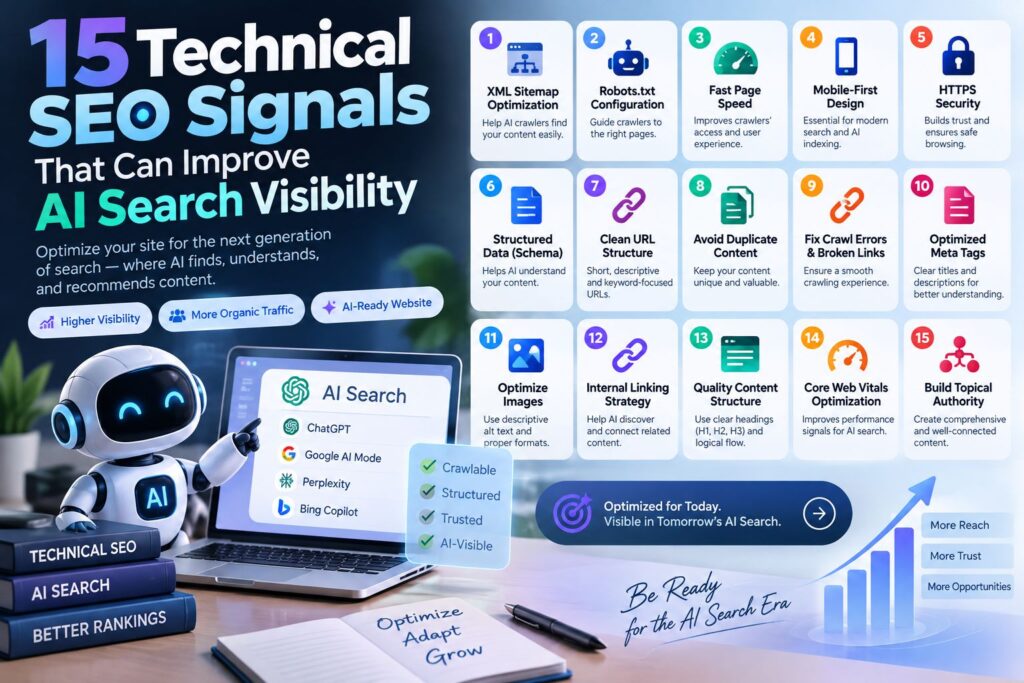
15 Technical SEO Signals That Can Improve AI Search Visibility
1. Make Your Website Crawlable
Before a search engine can understand your content, it needs to be able to access the page.
A technically strong website should not accidentally block important pages through robots.txt, server rules, authentication requirements, or other technical restrictions.
Check that your important pages are accessible to search engine crawlers and that your robots.txt file is not unnecessarily blocking important sections of the site.
You should also make sure that important pages are connected through normal internal links rather than being isolated.
Practical check: Review your robots.txt file and use Google Search Console to identify crawling or indexing problems.
To understand the broader shift from traditional rankings toward AI-powered discovery, see our guide on how AI Search is changing SEO.
2. Keep Important Pages Indexable
Crawling and indexing are not the same thing.
A crawler may successfully access a page, but that does not necessarily mean the page is eligible to appear in search results.
Review important pages for accidental noindex directives, incorrect canonical tags, duplicate versions, or other indexing problems.
For most valuable editorial pages, the goal should be simple: the correct URL should be accessible, indexable, and represented consistently across your website.
Quick checklist
- Check the page's indexability.
- Review the canonical URL.
- Look for accidental noindex tags.
- Make sure important pages are not orphaned.
- Inspect important URLs in Google Search Console.
Technical SEO for AI search starts with this basic foundation. If a useful page cannot be properly discovered or indexed, other optimization efforts have limited value.
You can also review Google’s indexing guidance when troubleshooting indexability issues.
3. Build a Clear Website Architecture
A clear website structure helps both users and search systems understand how your content is organized.
Instead of publishing hundreds of unrelated articles, group content into meaningful categories and topic areas.
For example, an AI-focused website might have categories such as:
AI Tools → AI Writing → AI SEO → AI Tutorials → AI for Students → AI for Business
This creates a logical relationship between broad subjects and more specific content.
A good architecture also makes internal linking easier. Your important pages should not be buried several clicks away from the homepage without a good reason.
The goal is not to create a complicated hierarchy. Simple, logical structures are usually easier to maintain and understand.
For a deeper strategy, see our guide to internal linking for AI search.
4. Use Descriptive and Consistent URLs
URLs provide another small piece of context about a page.
Compare:
example.com/p=2847
with:
example.com/technical-seo-ai-search/
The second URL gives a much clearer indication of the page’s subject.
Keep URLs short, descriptive, readable, and relevant to the actual content. Avoid adding unnecessary keyword variations simply because you want to target more searches.
A good URL should primarily help users and search systems understand what they are accessing.
5. Strengthen Internal Linking
Internal links are one of the most useful ways to connect related content across a website.
Suppose you publish a guide about technical SEO for AI search. It could naturally link to relevant articles about:
- AI search optimization
- Google AI search
- Look for accidentastructured data noindex tags.
- technical SEO audits
- AI visibility
These links help readers discover additional information while also establishing relationships between pages.
Avoid turning every internal link into an exact-match keyword. Natural anchor text is usually easier to read and gives the link genuine context.
Think of internal linking as building a content map, not simply distributing SEO signals.
Learn more about building this structure in our guide to internal linking for AI search.
6. Use Semantic HTML and Logical Headings
Your content should have a clear structural hierarchy.
Use one primary H1 for the main topic and organize supporting sections with appropriate H2 and H3 headings.
For example:
H1: Technical SEO for AI Search
H2: What Is Technical SEO for AI Search?
H2: 15 Technical SEO Signals
H3: Make Your Website Crawlable
H3: Strengthen Internal Linking
Semantic HTML elements such as headings, paragraphs, lists, tables, navigation elements, and other meaningful markup can also help browsers and search systems interpret the structure of a page.
The important point is not to insert keywords into every heading. Headings should describe the information that follows them.
7. Create Content That Directly Answers Questions
Technical SEO cannot compensate for content that does not satisfy the reader.
AI search systems often need to identify useful passages and information that directly addresses a user’s question.
That means your content should avoid unnecessary introductions and get to the point.
For example, instead of spending several paragraphs explaining that SEO is important, an article about canonical URLs could quickly explain:
What is a canonical URL?
A canonical URL tells search engines which version of a page should generally be treated as the preferred URL when multiple similar versions exist.
Then explain why it matters, when to use it, and how to implement it.
This answer-first approach improves usability while making the information easier to interpret.
8. Implement Relevant Structured Data
Structured data provides machine-readable information about certain types of content.
Depending on the page, relevant schema types can include:
- Article
- Breadcrumb
- Organization
- Person
- Product
- SoftwareApplication
- LocalBusiness
The important word is relevant.
Do not add schema simply because you want to add more markup. Structured data should accurately represent visible or applicable information on the page and follow the relevant search engine guidelines.
Schema can help search engines better understand what a page represents, but it should not be treated as a guaranteed method for appearing in AI answers.
9. Make Author and Publisher Information Clear
Trust and context matter when people evaluate online information.
For informational websites, clearly identifying the author or editorial team can help readers understand who is responsible for the content.
A strong article can include:
- Author name or editorial team
- Author bio where appropriate
- Publication date
- Updated date when content is meaningfully updated
- About page
- Contact information
- Publisher information
This does not mean adding unnecessary biography text to every page.
The objective is simply to make the website’s people, organization, and editorial responsibility easier to understand.
10. Use HTTPS and Maintain Website Security
HTTPS is now a basic requirement for a professional website.
Make sure your website consistently loads over HTTPS and does not create unnecessary mixed-content or redirect problems.
Also monitor your website for:
- Malware
- Hacked pages
- Suspicious redirects
- Unwanted scripts
- Broken security configurations
A technically accessible website still needs to be a safe destination for users.
Security is therefore part of the broader technical foundation supporting search visibility.
11. Improve Core Web Vitals and Page Experience
Performance matters because slow, unstable pages create a poor experience for visitors.
Core Web Vitals focus on aspects of real-world page experience, including loading performance, responsiveness, and visual stability.
You do not need to turn your website into an extremely minimal page just to chase a perfect score.
Instead, focus on practical improvements such as:
- Compressing large images
- Reducing unnecessary scripts
- Using efficient caching
- Improving server response time
- Avoiding layout shifts
- Removing unnecessary third-party resources
A fast website is better for users first. Good user experience and technical quality can then support the overall health of the site.
12. Make Your Website Mobile-Friendly
A large portion of web activity takes place on mobile devices, so your pages should work properly across different screen sizes.
Check that:
- Text is readable without zooming.
- Buttons are easy to tap.
- Navigation works correctly.
- Images fit the screen.
- Tables do not unnecessarily break the layout.
- Important content is available on mobile.
Responsive design should not mean creating a completely different version of your content for mobile.
The goal is to provide the same useful information in a usable format.
13. Control Duplicate Content and Canonical URLs
Large websites can accidentally create multiple URLs for essentially the same content.
This can happen through:
- URL parameters
- Category archives
- Tag pages
- Pagination
- HTTP/HTTPS variations
- WWW/non-WWW versions
- Trailing-slash inconsistencies
Canonical URLs can help communicate the preferred version of substantially similar pages.
However, canonicalization should not be used as a substitute for fixing serious duplicate-page problems.
Review your website’s URL patterns and make sure search engines can clearly understand which version should be considered the primary page.
Google’s structured data guidelines provide the technical and quality requirements to follow when implementing markup.
14. Keep Important Content Fresh
AI search visibility is not simply about publishing new articles every day.
Older content can remain valuable when it is accurate, useful, and maintained.
For articles covering fast-changing subjects such as AI tools, software, search features, or technology trends, outdated information can quickly reduce usefulness.
Instead of changing the publication date without making meaningful improvements, review older content and update it when there is something genuinely important to change.
A useful content maintenance process might include checking:
Facts → Links → Screenshots → Tools → Examples → Outdated claims
This creates a healthier content library than repeatedly publishing nearly identical articles.
You can learn more about our editorial approach on the About AIToolMind page.
15. Build Strong Topical and Entity Relationships
One of the biggest differences between traditional keyword targeting and modern search optimization is the importance of context.
A website should demonstrate meaningful relationships between related subjects.
For example, an AI SEO website might cover:
AI Search → Generative AI → Search Engines → GEO → Technical SEO → Structured Data → Content Optimization
Individual pages can then support one another through relevant internal links and consistent terminology.
This does not mean creating dozens of pages around tiny keyword variations.
Instead, build a useful collection of content that demonstrates genuine knowledge of a broader subject.
Topical depth is more valuable than publishing thin pages simply to target additional keywords.
Technical SEO vs. AI Search Optimization
| Area | Traditional SEO | AI Search |
|---|---|---|
| Crawlability | Essential | Essential |
| Indexability | Essential | Essential |
| Internal linking | Helps discovery | Helps establish context |
| Structured data | Helps machine understanding | Can provide additional structured context |
| Clear headings | Improves content structure | Makes information easier to interpret |
| Author information | Supports transparency | Helps establish source context |
| Page performance | Improves user experience | Supports accessible user experience |
| Topical depth | Builds relevance | Helps establish subject relationships |
The important takeaway is that AI search does not eliminate technical SEO.
Instead, strong technical foundations remain useful while content understanding and contextual relevance become increasingly important.
How to Audit Your Website for AI Search Visibility
You do not need an expensive enterprise SEO platform to begin.
Start with Google Search Console and a basic technical audit.
First, check whether your important pages are indexed. Then review your sitemap, robots.txt, canonical URLs, internal links, mobile experience, and page performance.
Next, look at your content structure.
Ask yourself:
Can a search engine quickly determine what this page is about, who created it, and how it relates to the rest of my website?
If the answer is unclear, the problem may not be a missing keyword. It may be the website's structure or content context.
Finally, review your most important pages manually. Look for outdated information, broken links, unnecessary repetition, unclear headings, excessive promotional language, and weak internal connections.
A technical audit should ultimately lead to a better website—not simply a longer SEO checklist.
Does Technical SEO Guarantee AI Search Visibility?
No.
There is no single technical SEO signal that guarantees inclusion in ChatGPT, Google AI experiences, Perplexity, Gemini, or another AI-powered search system.
AI search visibility can depend on many factors, including crawlability, content usefulness, relevance, source quality, query intent, freshness, authority, and the way individual search systems select and generate answers.
Technical SEO is therefore best viewed as a foundation.
If your website is difficult to crawl, poorly structured, slow, or full of indexing problems, improving content alone may not solve the problem.
But if the technical foundation is strong, useful content has a better environment in which to be discovered and understood.
Common Technical SEO Mistakes to Avoid
Many website owners make the mistake of treating AI SEO as a completely separate discipline.
They add excessive schema, create hundreds of pages targeting tiny keyword variations, repeatedly change titles, or stuff AI-related phrases into otherwise ordinary articles.
These tactics can create more problems than they solve.
Instead, focus on fundamentals: accessible pages, logical architecture, useful internal links, clean indexing, structured information, strong content, and a trustworthy website experience.
Do not optimize for an imaginary “AI ranking score.” There is no universal score that guarantees visibility across every AI search system.
Final Thoughts
Technical SEO for AI search is ultimately about making your website easy to access, understand, and navigate.
The 15 signals covered in this guide are not shortcuts to guaranteed AI visibility. They are foundational practices that can help search systems discover your content and understand its structure and context.
Start with the basics: crawlability, indexability, site architecture, internal linking, semantic structure, structured data, performance, mobile usability, and clean URLs.
Then build on that foundation with accurate content, clear authorship, meaningful topical relationships, and regular content maintenance.
The websites most prepared for AI-powered search will not necessarily be the ones using the most complicated SEO tricks. They will be the ones that make it easy for both people and machines to understand what they offer and why it is useful.
Frequently Asked Questions
What is technical SEO for AI search?
Technical SEO for AI search involves improving a website's technical structure so search engines and AI-powered search systems can access, crawl, understand, and interpret its content effectively.
Does technical SEO improve AI search visibility?
It can provide a stronger foundation for AI search visibility, but no technical SEO signal guarantees that a page will appear in an AI-generated answer or receive a citation.
What is the most important technical SEO signal for AI search?
There is no single most important signal. Crawlability, indexability, site structure, internal linking, content quality, and clear contextual relationships all contribute to a strong foundation.
Does schema markup help with AI search?
Relevant structured data can provide machine-readable information about a page, which can help search engines understand certain content types. However, schema markup does not guarantee AI search visibility.
Should I create separate content for AI search?
Not necessarily. Start by creating useful content for your audience and making sure your website has a strong technical foundation. AI search optimization should support good content rather than replace it.