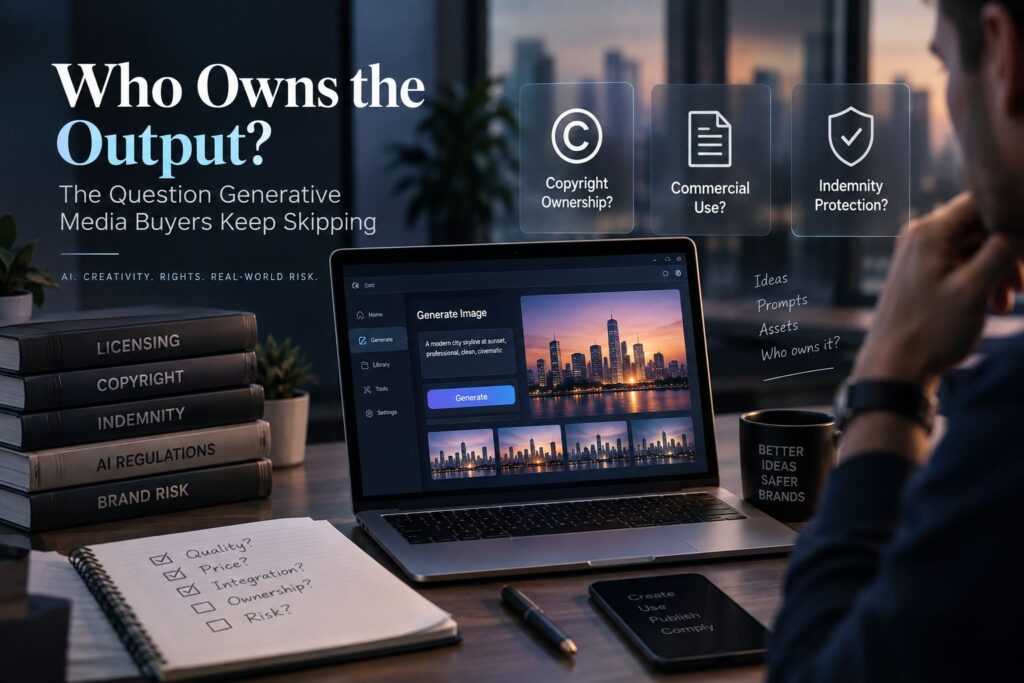
Who Owns the Output? The Question Generative Media Buyers Keep Skipping
As generative media reshapes advertising, ownership of AI-created outputs is becoming a critical question for modern media buyers.
The procurement conversation around generative image tools has settled into a comfortable pattern. Teams compare output quality, run a few prompts side by side, check the price per image, confirm it integrates with the existing workflow, and sign.
The question that almost never gets asked in that conversation is the one that determines what happens if something goes wrong: who carries the risk if the image you published turns out to infringe something?
It is worth being precise, because this area attracts a lot of confident nonsense in both directions.
The procurement conversation around generative image tools has settled into a comfortable pattern.
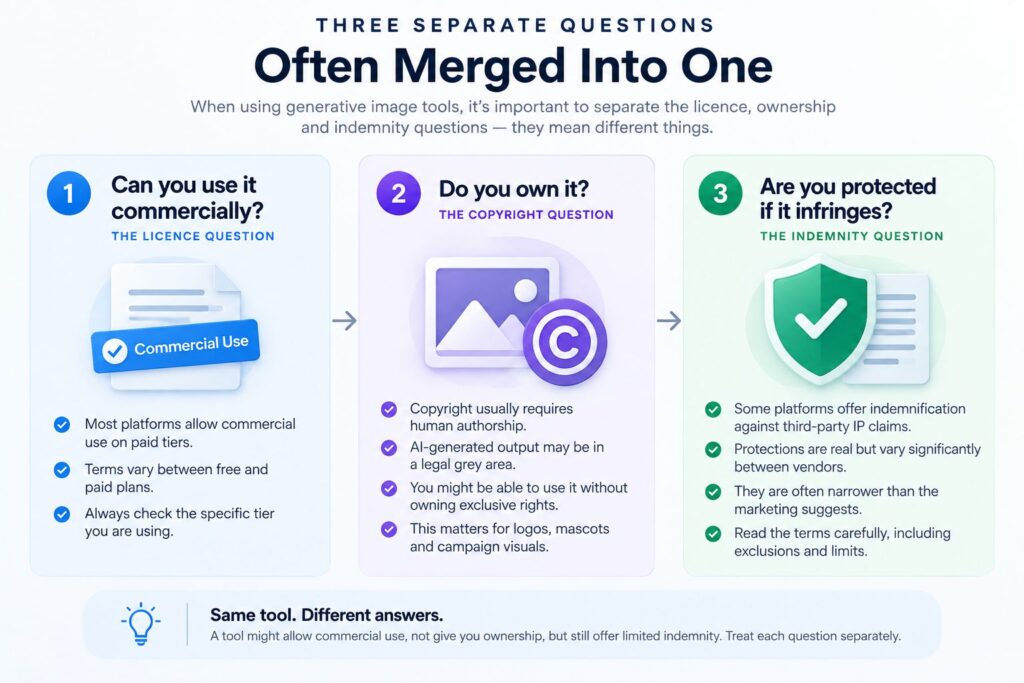
Three separate questions people merge into one
Can you use it commercially? This is the licence question, and it is the easy one. Every serious platform now grants commercial usage rights on paid tiers, with variations on free tiers. Read the tier you are actually on, because the difference between the free and paid grant is where most accidental violations happen — a designer trials a tool on a personal account, the output ships, and the licence covering it was never the one procurement negotiated.
Do you own it? This is the copyright question, and the answer in most jurisdictions is more awkward than vendors imply. Copyright protection generally attaches to human authorship. Output produced substantially by a model, from a short prompt, sits in contested territory — you may have the right to use it without holding an enforceable right to stop others from using the same thing. For a background texture, nobody cares. For a logo, a mascot or a campaign visual you intend to defend, it matters a great deal, and the answer varies by jurisdiction in ways that make a single global policy difficult.
Are you protected if it infringes? This is the indemnity question, and it is the one that should drive vendor selection. Several major platforms now offer indemnification against third-party IP claims arising from outputs. The protections are real and meaningfully differentiated — and they are also narrower than the marketing suggests.
Edgewisely’s comparison of the leading image platforms on licensing and who actually carries the copyright risk is a good grounding here, because it separates these questions rather than collapsing them into a single “is it safe” verdict.
Reading an indemnity properly
If your organisation is going to rely on a vendor indemnity, someone needs to read it with the following questions in hand.
What tier does it apply to? Indemnities are almost always enterprise-tier features. If half your team is on individual subscriptions, half your output is uncovered, and the half that is uncovered is the half nobody tracked.
Is it capped? Many indemnities are limited to fees paid. If you spend a modest amount annually on a tool and face a substantial infringement claim, a fees-capped indemnity is a gesture rather than a protection.
What conditions void it? Common voiding conditions include prompting with a third-party brand or artist name, disabling built-in filters, using outputs in prohibited categories, or modifying outputs beyond some threshold. The first of these is the important one, because prompting with reference to a known style or property is extremely common practice among creative teams and will void coverage on most of these agreements.
Who controls the defence? An indemnity that lets the vendor settle on terms that include you ceasing use of the asset is materially different from one that funds your chosen defence.
What is excluded entirely? Trademark claims are often excluded even where copyright is covered, and trademark is a realistic exposure for anything resembling a brand asset.
The disclosure layer nobody owns
Separate from ownership, there is a fast-moving obligation to tell people when they are looking at synthetic media. This is becoming a legal requirement in a growing number of places and a platform policy requirement in more, and the two do not have identical scope.
Teams using AI commercially should also understand how these tools fit into broader AI for Business workflows.
The organisational problem is that disclosure obligations attach to whoever publishes, while generation happens wherever someone has a tool and a deadline. In most companies nobody owns the join between those two facts. Marketing generates, an agency edits, a social team schedules, and no one along the chain has been told that a label is required or has authority to insist on one. Edgewisely’s account of which transparency obligations quietly became enforceable while everyone prepared for something else describes exactly this gap, and it is far more likely to catch a marketing organisation than any high-risk AI classification will.
A workable policy
You do not need a large governance apparatus for this. You need five decisions, written down, and someone whose job it is to enforce them.
Approved tools, by tier. One list. Enterprise tiers only, with indemnity terms on file. Individual subscriptions are not approved tools regardless of who is paying.
A prompting rule. No third-party brand names, artist names, or character references in prompts for anything that will be published. This is the single highest-value rule because it is the most common indemnity-voiding behaviour and the most common route to an actual infringement.
A use-tier classification. Generated imagery is fine for internal decks, social backgrounds and concept work. It requires review for campaign assets. It is prohibited for anything you intend to register or defend as a mark. Most disputes inside companies come from applying one standard to all three.
A provenance record. Which tool, which account, which date, which prompt. This costs almost nothing at generation time, and it is the difference between an answerable and an unanswerable question if a claim arrives eighteen months later.
A named disclosure owner. Someone in the publishing function, not in legal, who is responsible for labels appearing where they are required.
Teams can also use structured AI Tutorials to standardise how AI tools are used across creative workflows.
The question to ask vendors
If you are running a selection process, one question separates serious vendors from the rest, and it is not about output quality.
Ask them to describe, specifically, what happens on the day you receive a claim. Who do you contact. What do they require from you. How quickly do they respond. Have they done it before, and how did it go. Will they commit to a response time in the contract.
Vendors with genuine indemnity programmes have an answer to this, because they have built the process and, in several cases, used it. Vendors whose indemnity is a marketing line will give you a paragraph about their training data instead. The difference is immediately obvious and tells you more than any comparison of sample images.
A second question worth asking: what happens to your indemnity if you stop being a customer? Most protections are tied to an active subscription, which means assets generated during a contract and still in use afterwards may be uncovered. Campaign imagery has a long tail, and the tail frequently outlives the vendor relationship that produced it.
None of this slows creative work down meaningfully. All of it is cheaper than the alternative, which is discovering your exposure through a letter. The tools are genuinely useful and the risk is genuinely manageable — but only by organisations that treat the licensing question as seriously as they treat the output quality one, and most currently do not.