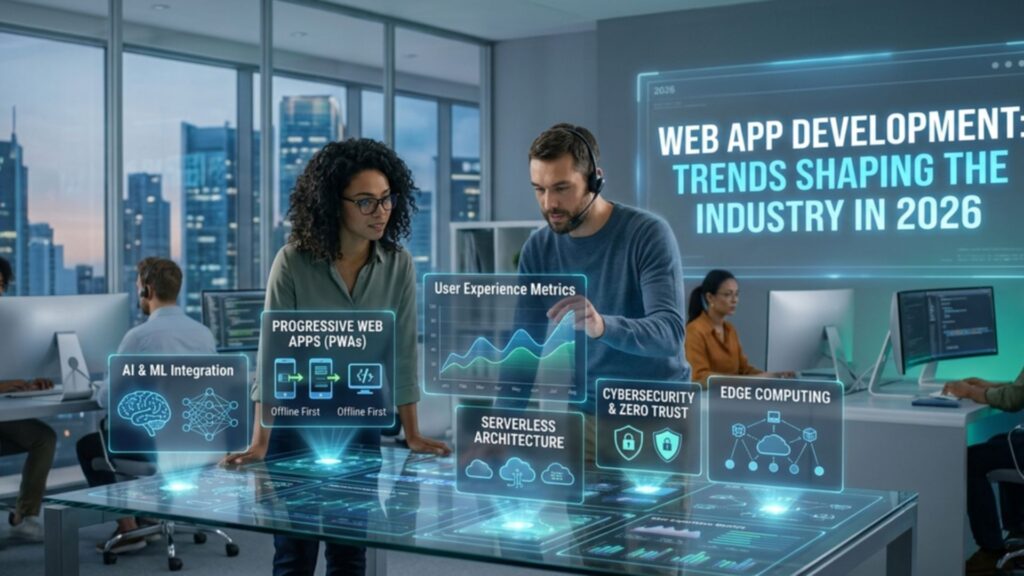
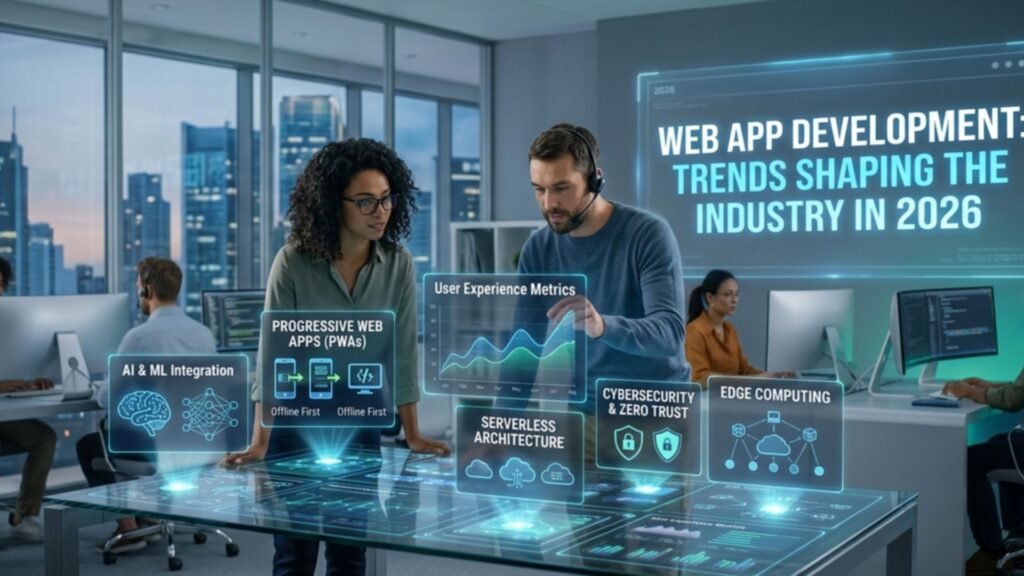
- The year 2026 will see web application development evolve rapidly, with web app development trends 2026 focusing on three key areas: artificial intelligence, cloud-native systems, and real-time performance capabilities, driving smarter, faster, and more scalable digital experiences.
- Modern applications depend on three core technologies which include application programming interfaces, microservices, and adaptable system designs.
- Web applications serve as essential tools for businesses to streamline their operational processes while delivering enhanced experiences to their customers.
- Organizations can reduce their costs through appropriate technical solutions which must be implemented at the project start. The organization needs to build systems which can grow according to their future requirements.
Web applications now serve as the core layer of digital products. They handle data processing while providing instant operational execution and user service access. Professional website application development services help companies build stable systems which support their long-term growth plans.
What drives modern web app development
Web development is influenced by growing demands from users and companies.
Users now expect applications to be fast, stable, and highly personalized, while businesses demand systems that support seamless integration, error-free scaling, and adaptability to change—making these needs a core part of web app development trends 2026.
The result are three main priorities for web developers:
- scalability
- performance
- innovation
Applications cannot stay the same anymore. Developers continuously improve them taking into account user needs and company requirements.
How AI becomes part of web applications
The AI is now embedded within the product and affects user engagement with the application.
Personalization based on behavior
Applications monitor user behavior and customize their experience.
This entails:
- Customized dashboards
- Product/content suggestions
- Dynamic user journey
Personalization enhances engagement and helps to keep users engaged within the product.
AI is now embedded within applications, and many AI tools for students are also influencing how developers build smarter and more interactive web applications.
Automation of workflows
AI makes tasks simpler in various scenarios.
Some common applications are:
- chatbots for customer support
- document categorization
- predictive analysis
Companies can save time and increase productivity.
AI in development processes
AI is helping developers accelerate the development process by automating tasks, improving efficiency, and reducing errors—making it a key driver of innovation in web app development trends 2026.
It is useful for:
- writing code
- identifying bugs
- automating testing
- web app development trends 2026
This enables developers to ship software updates more quickly and with fewer problems, reinforcing efficiency and reliability as core elements of web app development trends 2026.
AI is transforming industries, and AI tools for students are helping and developers alike improve productivity and learning outcomes.
Why API-first development is critical
The API-first architecture ensures that every part of the system communicates through well-defined interfaces, making seamless integration and scalability a natural part of web app development trends 2026.
It enables:
- the integration of external applications
- concurrent development of web and mobile interfaces
- changes without disrupting the system.
The API-first approach provides future flexibility.
What role microservices play
Microservices split applications into smaller independent parts.
Each service focuses on one function such as authentication, payments, or notifications.
Benefits
The system improves its performance through increased scalability of particular features and its capability to implement updates at a quicker pace and its enhanced operational reliability & web app development trends 2026.
Challenges
Complex system management is caused by the need to monitor and coordinate different software components or services.
Although microservices may very well add to these complexities, they help in building systems that can grow steadily without needing a massive rewrite.
How serverless changes development
Serverless computing eliminates the need for developers to handle infrastructure management tasks.
The developers work exclusively on the application’s core functionalities.
Key advantages
- auto-escalability
- less operational concerns
- reduced deployment time
Typical use cases
The system requires backend APIs to operate its event-driven workflows which enable data processing. Serverless architecture provides optimal performance for products which require both flexible resource usage and rapid business expansion.
Why Progressive Web Apps remain relevant
It integrates the accessibility of web apps with user experience like a mobile app.
Key benefits
- ast speed of loading
- can work offline
- device-independent performance
Businesses use PWAs to maintain a consistent user experience without having to maintain a seperate suite of mobile solutions.
How real-time features become standard
Users expect instant replies when they use applications. The system provides real-time functionality through three components which are instant notifications and live chat and collaborative features.
The applications become obsolete because they use outdated technology which requires users to wait for system updates.
What security trends shape development
Security is an essential component in web development.
Some important aspects of this are:
- zero trust approach to security
- authentication
- encryption of data
Web developers must also ensure that:
- code reviews are performed
- security testing is automated
- they comply with data laws
Good security keeps everyone safe.
How cloud-native development supports scalability
Cloud-native architecture enables applications to automatically adjust their capacity according to changing user demand. The system provides support for three main operational features which include high availability and fast deployment cycles and efficient resource usage. The method provides stable performance according to its design during periods of increased network traffic & web app development trends 2026.
What frontend trends improve user experience
Frontend development needs to achieve two goals which are fast performance and user-friendly design.
The three most common frameworks used in development today are React and Vue and Angular.
The main activities of the team include:
- designing systems that use components
- improving system performance
- connecting systems with headless CMS platforms
The system needs to provide quick and responsive user interfaces because this feature helps to increase user retention and active participation.
How low-code tools influence development
Low-code platforms enable developers to create basic applications within a short time frame.
The platform proves beneficial for:
- creating prototypes
- developing internal tools
- automating elementary business processes
Complex systems still need engineers to develop custom solutions.
Why DevOps is essential
DevOps connects development and operations to ensure continuous delivery.
The core practices of this system operate through three main components which include:
- automated testing
- continuous integration and deployment
- infrastructure as code
The system enables teams to launch updates more quickly while they keep their systems running smoothly.
How Cleveroad approaches web app development
Cleveroad specializes in creating scalable and efficient web applications.
The company develops the following services:
- custom architecture
- AI integration
- cloud infrastructure
- secure programming techniques
Such an approach allows companies to release their products quickly and efficiently.
Conclusion: what defines the future of web apps
The evolution of web applications is gradually evolving towards smarter and scalable solutions.
Some significant advancements include:
- Integration of artificial intelligence into basic functions
- Adoption of microservices and serverless technologies
- Real-time interaction as the standard approach
- Security considerations
- web app development trends 2026
Companies that follow these guidelines develop offerings that can adapt to growth and fit current requirements.