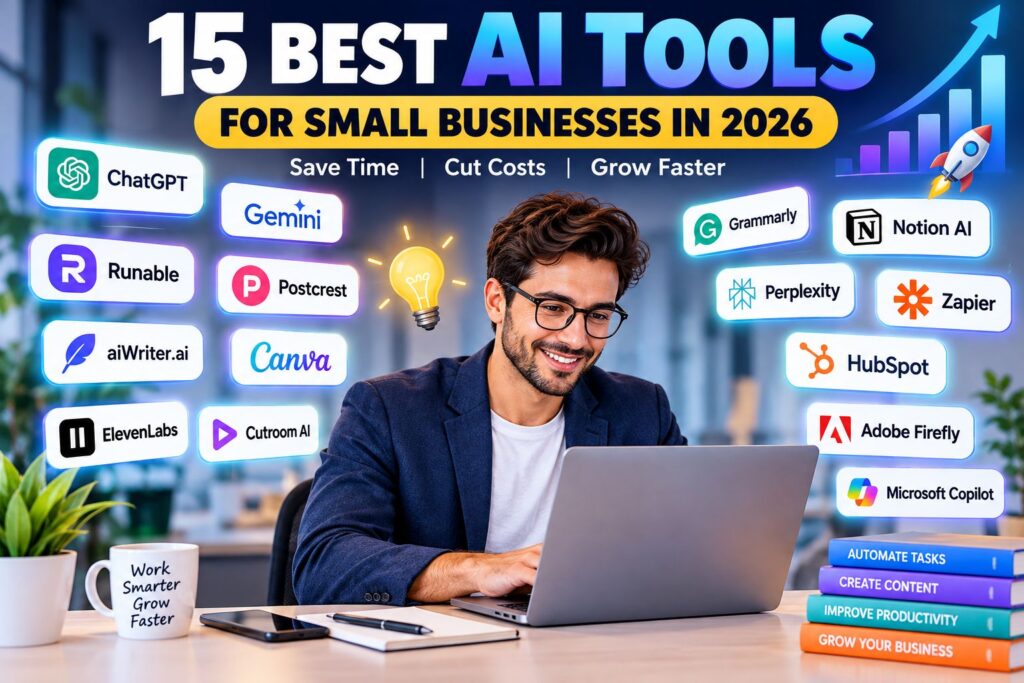
15 Best AI Tools for Small Businesses in 2026: Save Time, Cut Costs & Grow Faster
Discover the 15 best AI tools for small businesses in 2026 that can automate repetitive tasks, reduce costs, improve productivity, and help small teams grow faster without adding unnecessary complexity.
Running a small business in 2026 often means wearing several hats at once. You may be responsible for marketing, customer communication, content creation, social media, research, sales, and day-to-day operations.
That is where AI tools for small businesses can make a real difference.
Modern AI tools can help businesses write content, create images and videos, generate voiceovers, research topics, automate repetitive tasks, organize information, and improve everyday productivity.
The goal isn’t to replace people with AI. Instead, the right tools can help a small team spend less time on repetitive work and more time on customers, strategy, and growth.
In this guide, we’ll look at 15 of the best AI tools for small businesses in 2026, covering content creation, marketing, automation, research, design, communication, video, and productivity.
Affiliate Disclosure: Some links in this article are affiliate links. If you purchase a product or service through these links, we may earn a commission at no additional cost to you. This does not affect our recommendations.
AI is also changing how businesses approach AI Search Visibility and Technical SEO for AI Search as search continues to evolve.
Quick Comparison: Best AI Tools for Small Businesses
| AI Tool | Best For | Category |
|---|---|---|
| ChatGPT | Business assistance and content | Productivity |
| Runable | Business automation | Automation |
| Postcrest | Content and social media | Marketing |
| aiWriter.ai | AI writing | Content |
| ElevenLabs | AI voice and audio | Voice |
| Cutroom AI | Video creation and editing | Video |
| Canva | Graphics and marketing | Design |
| Gemini | Research and productivity | AI Assistant |
| Grammarly | Business writing | Communication |
| Notion AI | Team productivity | Productivity |
| Perplexity | Business research | Research |
| Zapier | Workflow automation | Automation |
| HubSpot | Marketing and CRM | Business |
| Adobe Firefly | AI images and creative work | Design |
| Microsoft Copilot | Office productivity | Business |
1. ChatGPT — Best Overall AI Assistant for Small Businesses
ChatGPT can be useful as an everyday AI assistant for small business owners.
You can use it to brainstorm marketing ideas, draft emails, create social media content, summarize information, develop business plans, research topics, prepare customer responses, and generate ideas for new campaigns.
For example, a local business could use ChatGPT to create a week’s worth of social media ideas, while an online store could use it to brainstorm product descriptions and promotional copy.
Best for:
- Business brainstorming
- Content creation
- Email writing
- Research
- Customer communication
- Marketing ideas
- Business planning
Why small businesses may like it
One of the biggest advantages of a general-purpose AI assistant is flexibility. Instead of using a separate tool for every small task, business owners can use one AI assistant for a wide range of everyday work.
2. Runable — AI Automation for Business
Repetitive tasks can consume a surprising amount of time, especially when a small team is handling multiple responsibilities.
Runable focuses on AI-powered business automation and can help businesses streamline workflows and reduce repetitive manual work.
For businesses that are trying to improve their operations without adding more administrative work, automation can be particularly useful.
Best for:
- Business automation
- Repetitive tasks
- AI-powered workflows
- Business operations
- Productivity
Why small businesses may like it
The less time a team spends on repetitive processes, the more time it can spend on customers, sales, and business growth.
3. Postcrest — Best for AI Content and Social Media
Creating content consistently is one of the biggest challenges for many small businesses.
Postcrest can help businesses create different types of marketing content, including images, videos, voice content, music, captions, editing, and social media content.
This can be useful for businesses that want to maintain an active presence across social platforms without creating every piece of content completely from scratch.
Best for:
- Social media content
- Marketing videos
- AI images
- Captions
- Content creation
- Social media workflows
Why small businesses may like it
A local business, online store, agency, consultant, or service provider can use AI-powered content creation to produce marketing material more consistently.
4. aiWriter.ai AI Writing for Business Content
Writing blog posts, website copy, product descriptions, and marketing material can take a lot of time.
aiWriter.ai can help businesses generate and develop written content with AI, making it useful for companies that publish content regularly.
Instead of starting every article or marketing message from a blank page, businesses can use AI to create a starting point and then edit the content to match their brand, expertise, and audience.
Best for:
- Blog content
- Marketing copy
- Website content
- Product descriptions
- Content ideas
- Drafting
Why small businesses may like it
AI writing tools can speed up the initial drafting process, allowing business owners and content teams to focus more on editing, fact-checking, and adding their own expertise.
👉 Explore aiWriter.ai5. ElevenLabs — AI Voice Generation
Video and audio content have become important parts of digital marketing.
ElevenLabs provides AI voice technology that can be useful for voiceovers, narration, promotional videos, educational content, presentations, and other audio projects.
For example, a small business creating short promotional videos can use AI voice technology to produce narration without recording every video manually.
Best for:
- Voiceovers
- Video narration
- Educational content
- Marketing videos
- Audio content
- Narration
Why small businesses may like it
Professional voiceovers can make marketing videos and educational content more engaging while reducing the time required to record and edit audio.
👉 Try ElevenLabs6. Cutroom AI — AI Video Editing
Video is one of the most effective formats for social media marketing, but editing videos manually can be time-consuming.
Cutroom AI can help simplify video creation and editing workflows, making it useful for businesses that regularly create short-form or promotional video content.
Best for:
- Video editing
- Social media videos
- Marketing videos
- Short-form content
- Video production
Why small businesses may like it
A small business can use AI-assisted video workflows to produce more content without spending hours editing every individual video.
👉 Try Cutroom AI7. Canva — AI Design for Marketing
Not every small business can afford to hire a professional designer for every marketing task.
Canva makes it easier to create social media graphics, presentations, advertisements, posters, thumbnails, documents, and other visual content.
Its AI-powered features can also help users generate and modify creative assets.
Best for:
- Social media graphics
- Presentations
- Advertisements
- Posters
- Thumbnails
- Marketing materials
Why small businesses may like it
A business owner can create professional-looking marketing material without needing advanced graphic design skills.
This can be especially useful for social media posts, promotional campaigns, presentations, and everyday business communication.
8. Gemini — AI Research and Productivity
Google Gemini can assist with research, brainstorming, writing, summarization, and other productivity tasks.
Small businesses can use AI assistants like Gemini to organize information, develop ideas, summarize material, and support everyday business tasks.
Best for:
- Research
- Brainstorming
- Writing
- Summarization
- Productivity
- Idea generation
Why small businesses may like it
Business owners often need to process information quickly. An AI assistant can help organize information and reduce the time spent on some routine tasks.
9. Grammarly — AI Writing Assistant
Professional communication matters when you’re dealing with customers, clients, employees, suppliers, or business partners.
Grammarly can help improve writing, grammar, clarity, tone, and overall communication.
Best for:
- Business emails
- Website copy
- Client communication
- Grammar checking
- Professional writing
- Editing
Why small businesses may like it
Clear and professional communication can make emails, proposals, website content, and customer messages easier to understand.
For businesses that communicate with customers in English, a writing assistant can also help improve consistency and readability.
10. Notion AI — Business Organization and Productivity
Small teams need an effective way to organize documents, notes, projects, ideas, and internal information.
Notion combines workspace and productivity features, while its AI capabilities can assist with tasks such as summarization, writing, and organizing information.
Best for:
- Project organization
- Team documentation
- Notes
- Business planning
- Knowledge management
- Internal workflows
Why small businesses may like it
Keeping important information in one organized workspace can make it easier for teams to find documents, track projects, and collaborate.
11. Perplexity — AI-Powered Research
Research is an important part of running almost any business.
Perplexity can help users research topics and find information through an AI-powered search experience.
Small businesses can use research tools for market research, competitor research, content research, product research, and gathering information before making business decisions.
Best for:
- Market research
- Competitor research
- Content research
- Topic research
- Information discovery
Why small businesses may like it
Research can involve opening and comparing many different sources. AI-powered research tools can help users organize information more efficiently.
Businesses should still verify important information before relying on it for financial, legal, medical, or other high-stakes decisions.
12. Zapier — AI Workflow Automation
Many businesses use several applications every day.
Zapier can connect different applications and automate workflows between them.
For example, a business could create a workflow that sends information from a form to another application whenever a new lead submits their details.
Best for:
- Workflow automation
- Connecting apps
- Lead management
- Repetitive tasks
- Business processes
- Productivity
Why small businesses may like it
Automation can reduce repetitive administrative work and help businesses create more consistent processes.
Instead of manually moving information between applications, businesses can automate parts of the workflow.
13. HubSpot — AI for Marketing and Customer Management
Small businesses need to manage leads, customers, marketing campaigns, sales activities, and communication.
HubSpot provides tools for CRM, marketing, sales, customer service, and other business functions, with AI capabilities integrated into its platform.
Best for:
- CRM
- Marketing
- Sales
- Customer management
- Lead generation
- Business communication
Why small businesses may like it
A centralized customer management system can make it easier to organize customer information, track leads, and manage marketing and sales activities.
14. Adobe Firefly — AI Creative Tools
Visual content is an important part of modern marketing.
Adobe Firefly provides generative AI capabilities for creating and modifying creative content.
It can be useful for businesses that need marketing graphics, visual concepts, and creative assets.
Best for:
- AI images
- Creative concepts
- Marketing graphics
- Visual content
- Creative experimentation
Why small businesses may like it
AI creative tools can help small teams generate visual ideas and assets more quickly, particularly during the early stages of a marketing campaign.
Businesses should always review generated content before publishing it, especially when brand identity and commercial use are important.
15. Microsoft Copilot — AI for Office and Business Productivity
Many small businesses already use Microsoft products for documents, spreadsheets, presentations, email, and collaboration.
Microsoft Copilot brings AI capabilities into Microsoft’s productivity ecosystem.
Best for:
- Documents
- Presentations
- Business productivity
- Microsoft 365 workflows
- Workplace assistance
- Everyday office tasks
Why small businesses may like it
Businesses already using Microsoft’s ecosystem may find it useful to have AI assistance integrated into familiar productivity workflows.
Best AI Tools for Different Small Business Needs
There isn't one AI tool that is perfect for every business. The right choice depends on what your business actually needs.
Best AI Tools for Content Creation
Consider:- Postcrest
- aiWriter.ai
- ChatGPT
- Canva
Best AI Tools for Video Creation
Consider:- Cutroom AI
- Postcrest
- ElevenLabs
Best AI Tool for Voiceovers
Consider:- ElevenLabs
Best AI Tools for Business Automation
Consider:- Runable
- Zapier
Best AI Tools for Research
Consider:- Perplexity
- Gemini
- ChatGPT
Best AI Tools for Graphic Design
Consider:- Canva
- Adobe Firefly
Best AI Tools for Business Writing
Consider:- ChatGPT
- Grammarly
- aiWriter.ai
Best AI Tools for Customer and Marketing Management
Consider:- HubSpot
- ChatGPT
- Zapier
How Small Businesses Can Use AI to Save Time
The biggest benefit of AI isn’t simply having access to more technology.
The real value comes from using AI to reduce repetitive work and improve existing workflows.
For example, a small business could build a simple content workflow like this:
Step 1: Research the Topic
Use ChatGPT or Perplexity to brainstorm ideas and research the topic.
Step 2: Create the Written Content
Use an AI writing tool such as aiWriter.ai to develop an initial draft.
Step 3: Create Visual Content
Use Canva or Postcrest to create images, social media graphics, or other visual assets.
Step 4: Add a Voiceover
Use ElevenLabs when the content requires narration or voiceover.
Step 5: Create or Edit the Video
Use Cutroom AI to turn the content into a short-form or promotional video.
Step 6: Distribute the Content
Use your preferred social media scheduling platform to publish the content across your channels.
A single business idea can therefore become a blog post, social media graphics, captions, short videos, and audio content.
How to Choose the Right AI Tool for Your Small Business
With hundreds of AI tools available, it can be tempting to subscribe to everything.
That’s usually unnecessary.
Start by identifying the biggest problem in your business.
1. What Takes the Most Time?
If writing takes several hours every week, an AI writing assistant may be useful.
If video editing consumes most of your time, look for an AI video tool.
2. Which Tasks Are Repetitive?
If your team repeatedly moves information between applications, automation tools may help.
3. What Type of Content Do You Need?
Think about whether your business needs:
- Blog posts
- Social media graphics
- Videos
- Voiceovers
- Presentations
- Product descriptions
- Emails
Then choose tools that directly support those needs.
4. Does the Tool Fit Your Budget?
Many AI platforms offer free plans, trials, or different subscription levels.
Test a tool before committing to a long-term subscription whenever possible.
5. Will Your Team Actually Use It?
The most advanced AI tool isn’t necessarily the most useful one.
If a tool is difficult to understand or doesn’t fit your existing workflow, it may create more complexity instead of saving time.
The right choice depends on what your business actually needs. Choosing the right AI tools can help you improve productivity, reduce repetitive work, and get better results.Do Small Businesses Really Need AI Tools?
Not necessarily.
AI tools are useful when they solve a real business problem.
A small business doesn’t need to subscribe to 10 or 20 AI platforms simply because they are popular.
Instead, start with one or two tools that address your biggest challenges.
For example:
Content problem: Start with an AI writing or content creation tool.
Video problem: Try an AI video creation or editing tool.
Automation problem: Start with an automation platform.
Research problem: Use an AI research assistant.
Design problem: Try an AI-powered design platform.
As your business grows, you can add more tools when there is a clear reason to do so.
If you’re exploring more AI solutions for different business tasks, you can browse our AI Tools collection to discover more useful platforms. You can also explore our AI Resources for additional tools, guides, and practical resources.
A Simple AI Toolkit for a Small Business
If you’re just starting with AI, you don’t need all 15 tools.
A simple combination could look like this:
For general business tasks: ChatGPT
For content creation: Postcrest
For writing: aiWriter.ai
For voiceovers: ElevenLabs
For video: Cutroom AI
For design: Canva
For research: Perplexity
For automation: Runable or Zapier
This gives a small business coverage across many common digital workflows without requiring a huge collection of software.
Final Thoughts
AI has become increasingly accessible to small businesses in 2026.
You don’t need a large team or a huge technology budget to start using AI. A few carefully selected tools can help with writing, marketing, research, design, video, voice, customer management, and automation.
The key isn’t to use AI everywhere.
Instead, identify the tasks that consume the most time and find a tool that can make those tasks faster, easier, or more consistent.
For content-focused businesses, tools such as Postcrest, aiWriter.ai, ElevenLabs, and Cutroom AI can support different parts of the content workflow.
For automation, Runable and Zapier can help streamline repetitive processes.
For general productivity, tools such as ChatGPT, Gemini, Notion AI, and Microsoft Copilot can assist with everyday business tasks.
Start small, measure the results, and expand your AI toolkit as your business needs grow.
Frequently Asked Questions
Find answers to common questions about choosing, using, and getting value from AI tools for small businesses.
1 What are the best AI tools for small businesses in 2026?
The best AI tool depends on the specific needs of the business. Common categories include AI writing, content creation, video editing, research, design, automation, CRM, and productivity.
2 Can AI tools save small businesses money?
AI can reduce the time required for certain repetitive tasks and may reduce the need to outsource some basic work. However, actual savings depend on the business, workflow, tool costs, and how effectively the technology is used.
3 Are AI tools expensive?
Not necessarily. Many AI tools offer free plans, trials, or different subscription levels. Businesses should compare features and pricing before choosing a tool.
4 What is the best AI tool for small-business content creation?
It depends on the type of content you need. AI writing tools can help with articles and copy, while platforms such as Postcrest can support broader content and social media creation.
5 Can small businesses use AI for social media?
Yes. AI can help with content ideas, captions, images, videos, voiceovers, and parts of the social media workflow.
6 Should a small business use multiple AI tools?
It can, but using too many tools can create unnecessary costs and complexity. It's usually better to start with a few tools that directly solve important business problems.
7 How can a small business start using AI?
Start with one business problem. For example, if content creation takes too much time, begin with an AI content tool. If repetitive administrative work is the problem, consider an automation tool. Test the results before adding more software.
8 Can AI replace employees in a small business?
AI is better viewed as a productivity tool rather than a complete replacement for people. Human judgment, creativity, customer relationships, business knowledge, and quality control remain important.
Choose AI Tools Based on Your Business Needs
The best AI strategy for a small business isn't to use the most AI tools. It's to use the right AI tools for the right problems.
Choose tools that save meaningful time, improve your workflow, and provide enough value to justify their cost. Then measure the results and keep the tools that genuinely help your business.