AI Search Visibility: How to Get Your Website Cited in Google AI Overviews, ChatGPT & Perplexity in 2026
Learn how AI search engines discover, understand, mention, and cite websites—and discover practical strategies to improve your visibility across Google AI Overviews, ChatGPT, and Perplexity.
Search is changing.
People are no longer relying only on traditional search engines to find information, compare products, research businesses, or make purchasing decisions. They are increasingly using AI-powered experiences such as ChatGPT, Perplexity, Google AI Overviews, Google AI Mode, Gemini, and Microsoft Copilot to get direct answers.
That creates a new visibility challenge for website owners:
How do you make sure your brand and content appear when an AI system answers a question related to your industry?
This is where AI search visibility comes in.
Unlike traditional SEO, where marketers often focus on keyword rankings and positions in Google’s search results, AI search visibility looks at whether your brand is mentioned, cited, linked, or recommended inside AI-generated answers.
In this guide, you’ll learn what AI search visibility means, how AI search differs from traditional search, how Google AI Overviews and ChatGPT use web content, and what you can do to increase your chances of being discovered and cited.
What Is AI Search Visibility?
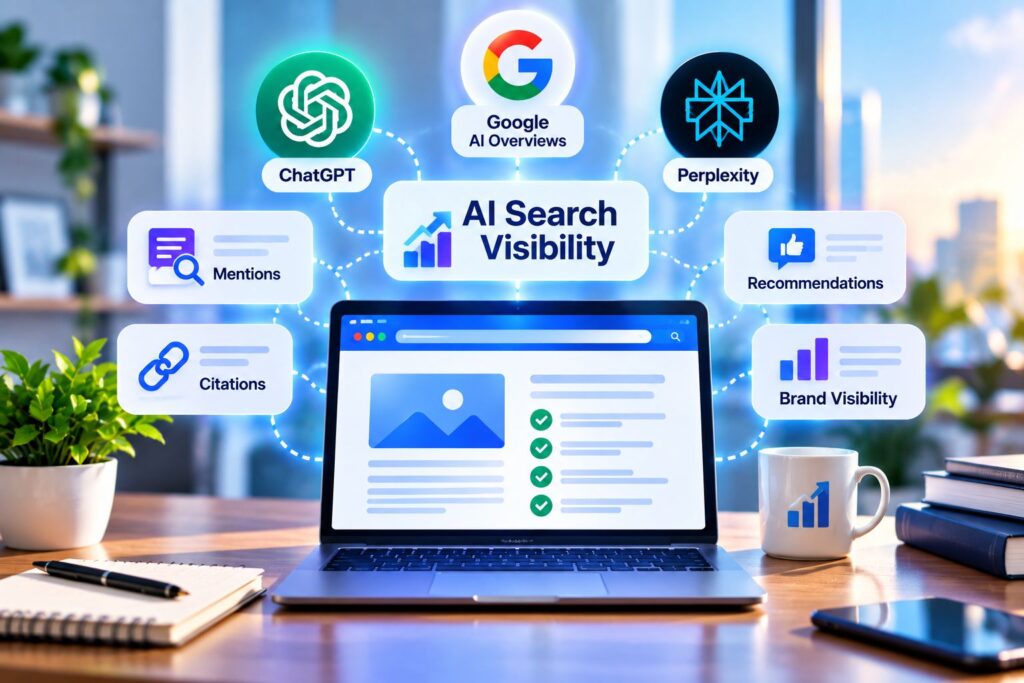
AI search visibility measures how often and how prominently your brand, website, products, or content appear in AI-generated answers across platforms such as ChatGPT, Perplexity, Google AI Overviews, Gemini, and other AI search experiences.
There are several ways a website can become visible in an AI-generated answer.
Key Types of AI Visibility
Cited and linked:
An AI system mentions your website and provides a clickable link to the page used as a source.
Mentioned but not linked:
The AI system names your brand, product, or website but does not provide a direct link.
Recommended:
Your brand or product is included as one of several options when a user asks for recommendations.
Not visible:
Your brand does not appear even though competitors or other sources are mentioned.
This means AI visibility is broader than simply asking whether your page “ranks.”
s AI-powered search continues to evolve, understanding how Google AI Search is changing SEO can help website owners adapt their content and visibility strategies.
How AI Search Visibility Differs from Traditional SEO
Traditional SEO generally focuses on improving a website’s visibility in conventional search results.
AI search introduces another layer: whether your information is selected and represented inside an AI-generated response.
Here are some important differences:
- Traditional SEO: Often measured through keyword rankings, impressions, clicks, and organic traffic.
- AI search: Can be measured through mentions, citations, share of voice, visibility across prompts, and AI-driven traffic.
- Traditional search: Usually presents a list of results that users evaluate themselves.
- AI search: Can synthesize information from multiple sources into a conversational response.
- Traditional SEO: Keyword relevance, technical SEO, links, content quality, and many other signals matter.
- AI search: Still relies heavily on discoverable, relevant web content, while the way information is retrieved and presented can vary by platform.
Importantly, AI search does not make traditional SEO obsolete. Google explicitly states that its existing SEO fundamentals remain relevant to AI Overviews and AI Mode.
Core AI Visibility Metrics to Track
If you’re serious about AI search, don’t track mentions alone.
Consider monitoring:
- Platform visibility: How often your brand appears across ChatGPT, Google AI features, Perplexity, Gemini, and other platforms.
- Share of voice: How frequently your brand appears compared with competitors for relevant prompts.
- Citations: Which pages and domains AI systems use as sources.
- Brand mentions: How frequently your brand is named.
- Sentiment: Whether the surrounding description is positive, neutral, or negative.
- AI referral traffic: Whether AI-generated answers actually send visitors to your website.
Modern AI visibility tools increasingly measure metrics such as mentions, citations, impressions, and AI share of voice.
Traditional SEO mainly focuses on rankings and organic traffic, while AI search introduces additional visibility opportunities such as mentions, citations, and recommendations. To understand these different forms of AI visibility, explore our guide to the 3 layers of AI visibility.
How AI Search Is Different from Traditional Google Search
Traditional Google Search generally presents a ranked set of results that users can open and evaluate.
AI search can instead interpret a conversational question, retrieve relevant information, and generate a synthesized response.
How Information Is Delivered
Traditional Search:
You enter a query and receive search results. You then open multiple pages, compare information, and form your own conclusion.
AI Search:
An AI system may interpret the question, retrieve relevant information, synthesize information from multiple sources, and present the result conversationally with supporting citations or links.
Google’s AI features can also use a process known as query fan-out, where a complex question is broken into related searches to gather information from different areas.
User Behavior and Queries
Traditional searches are often short:
“best AI writing tools”
AI search queries can be much more conversational:
“What are the best AI writing tools for a small business that needs SEO-friendly blog content?”
The second type of query contains more context, constraints, and intent.
That means your content needs to answer not only individual keywords but also the underlying questions and problems users are trying to solve.
Ranking and Optimization Focus
Traditional SEO still matters.
Google’s current guidance makes this particularly clear: AI Overviews and AI Mode are built on Google’s existing Search systems, and pages generally need to be indexed and eligible to appear in normal Search before they can be used as supporting links in these AI features.
At the same time, AI search introduces additional considerations such as:
- Clear entity information
- Direct answers
- Strong topical coverage
- Original information
- Factual accuracy
- Easy-to-understand page structure
- Relevant third-party references
- Strong brand presence across the web
Google Search Central — Optimizing for Generative AI Features
When Should You Use Traditional Search vs. AI Search?
Traditional search is useful when you want to:
- Visit a specific website
- Compare multiple independent sources
- Find local businesses
- Verify information manually
- Navigate directly to a known page
AI search can be useful when you want to:
- Explore a complex topic
- Compare multiple options
- Ask follow-up questions
- Summarize information
- Research a problem conversationally
For website owners, the practical takeaway is simple:
Don’t choose between SEO and AI search. Build content that can perform in traditional search while also being useful when AI systems retrieve and summarize information.
How Google AI Overviews Choose Sources
Google AI Overviews use Google’s Search systems and generative AI techniques to provide synthesized answers for certain queries.
Google says AI Overviews and AI Mode may use query fan-out, sending multiple related searches across subtopics and data sources to develop a response. The systems can then identify supporting web pages and display relevant links.
How the Process Works
A simplified version looks like this:
- User asks a question
For example:
“What are the best AI tools for creating marketing videos?”
- Google interprets the query
The system determines what the user is trying to accomplish.
- Related searches may be generated
For complex queries, Google’s AI systems may explore related subtopics.
- Relevant web content is retrieved
Google’s existing Search infrastructure helps identify potentially useful pages.
- The AI response is generated
The system synthesizes information and can provide links to supporting websites.
What Can Improve Your Chances of Appearing?
There is no guaranteed formula for getting cited in an AI Overview.
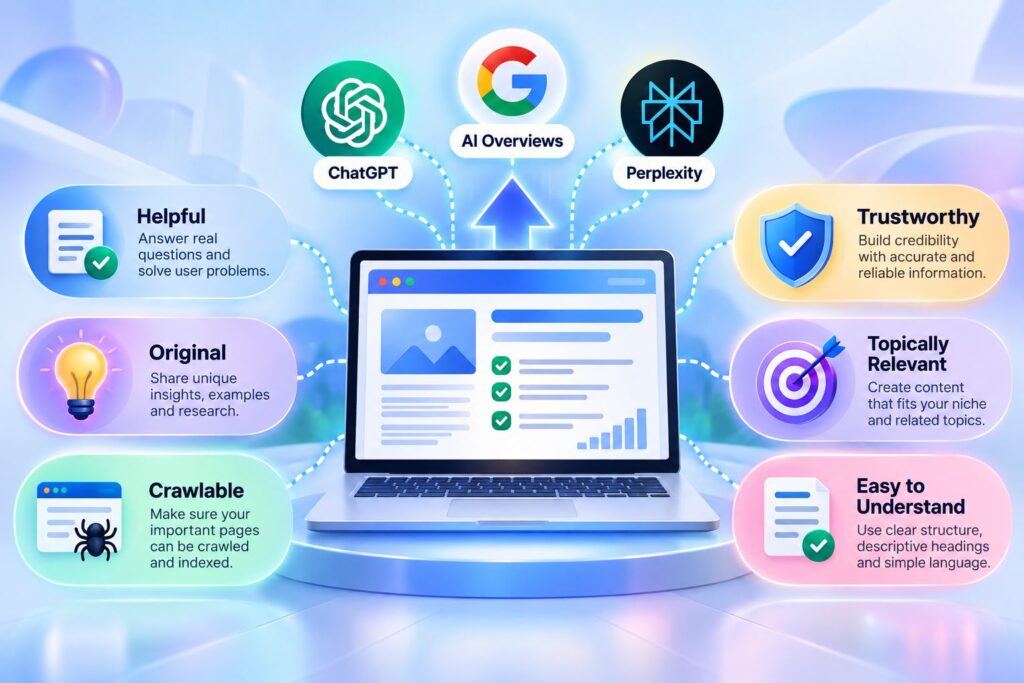
However, the fundamentals remain important:
Create Helpful, People-First Content
Your content should answer the user’s actual question rather than being created primarily to manipulate search engines.
Make Important Information Easy to Find
Use:
- Descriptive headings
- Short paragraphs
- Lists
- Tables where appropriate
- Clear definitions
- Useful examples
- Original information
Strengthen Your Website’s Topical Coverage
Instead of publishing dozens of unrelated articles, create connected content around a clear subject.
For example:
AI SEO
→ AI Search Visibility
→ Technical SEO for AI Search
→ ChatGPT Search Optimization
→ Perplexity SEO
→ GEO vs SEO
→ AI Search Tracking
→ AI Visibility Tools
Build Trust and Expertise
Use:
- Author bios
- Relevant credentials
- First-hand experience
- Original research
- Accurate statistics
- Clear sources
- Updated information
Google’s guidance emphasizes helpful, reliable, people-first content rather than special AI-search hacks.
How to Get Your Website Cited in AI Overviews
There is no guaranteed way to force Google AI Overviews to cite a particular page.
However, you can make your content easier for search systems and users to understand.
Answer Questions Directly
Don’t make readers search through five paragraphs before finding the answer.
For example:
Weak:
AI search has become an important development in the digital marketing industry…
Better:
AI search visibility is the ability of a brand or website to appear in AI-generated answers through mentions, citations, links, or recommendations.
The second version immediately answers the question.
Structure Content Clearly
Use:
- Question-based headings
- Numbered steps
- Bullet points
- Comparison tables
- Definitions
- Examples
- Short explanatory paragraphs
But don’t create artificial “AI chunks” simply because someone claims a particular word count guarantees citations.
Google’s current guidance specifically warns against treating tactics such as excessive content chunking or unnecessary AI files as guaranteed optimization methods.
Continue Doing Traditional SEO
Your AI-search strategy should still include:
- Crawlability
- Indexability
- Internal linking
- Quality backlinks
- Helpful content
- Strong page experience
- Descriptive titles
- Relevant headings
- Structured data where appropriate
Google states that there are no additional technical requirements specifically for AI Overviews or AI Mode beyond being eligible for normal Google Search.
Keep Important Information Fresh
For topics that change quickly, update:
- Statistics
- Product information
- Pricing
- Examples
- Screenshots
- Dates
- Tool features
- Industry developments
Don’t add a new year to a title simply to make old information look fresh. Update the actual content.
How to Get Cited by ChatGPT
ChatGPT Search can surface public websites and provide links to web sources.
OpenAI’s current publisher guidance says that websites should avoid blocking OAI-SearchBot if they want their content to be discoverable and included in ChatGPT search summaries and snippets.
So instead of thinking about “ranking #1 in ChatGPT,” think about making your content discoverable, useful, clear, and trustworthy.
Key Strategies
- Answer the Question Clearly
Start important sections with a concise answer.
For example:
“Generative Engine Optimization (GEO) is the practice of improving content so that AI search systems can understand, retrieve, and potentially reference it.”
Then provide supporting detail.
- Publish Original Information
AI systems have access to enormous amounts of repetitive information.
Original material gives your website something more valuable to contribute.
Consider publishing:
- Original research
- Surveys
- Experiments
- Benchmarks
- Case studies
- First-hand testing
- Original screenshots
- Expert commentary
- Cover Conversational Search Intent
Don’t only target:
“best AI tools”
Also cover questions such as:
“What is the best AI writing tool for a small business?”
“Which AI tools can create long-form SEO content?”
“What is the difference between AI writing assistants and traditional SEO tools?”
- Build a Strong Web Presence
Your website should not be the only place where your brand exists.
Relevant mentions across:
- Industry publications
- Communities
- Reviews
- Professional profiles
- News websites
- Forums
- Social platforms
can help establish broader context around your brand.
The goal should be genuine reputation and useful participation, not artificial mention-building.
- Make Your Site Technically Accessible
Check that important content is:
- Crawlable
- Indexable
- Available in HTML
- Not accidentally blocked
- Internally linked
- Accessible without unnecessary barriers
For ChatGPT specifically, OpenAI currently identifies OAI-SearchBot as the crawler publishers should allow for inclusion in ChatGPT search summaries and snippets.
How to Get Mentioned by Perplexity
Perplexity is designed around answering questions with web-backed information and citations.
That makes source quality, clarity, relevance, and crawlability important considerations.
Content Structure
Answer First
Start sections with the answer instead of a long introduction.
Use Scannable Formatting
Use:
- Tables
- Lists
- Step-by-step instructions
- Comparisons
- Definitions
- Short paragraphs
Include Verifiable Information
Whenever appropriate, support important claims with:
- Statistics
- Original research
- Expert statements
- Product specifications
- Official documentation
- Primary sources
Use Descriptive Headings
Instead of:
“Important Things to Know”
Use:
“How Does AI Search Visibility Work?”
Specific headings make the purpose of each section clearer to both users and search systems.
Technical and Off-Site Considerations
Check your site’s crawler access and make sure important pages are not unintentionally blocked.
Also build genuine authority beyond your own website through relevant:
- Industry publications
- Reviews
- Communities
- Expert discussions
- Digital PR
- Professional profiles
The objective isn’t to manufacture mentions. It’s to establish your brand as a legitimate source within its topic.
10 AI Search Visibility Signals to Track
AI visibility is more useful when you measure it systematically.
Here are 10 practical signals to monitor.
- Brand Mention Frequency
How often does an AI platform mention your brand when users ask relevant questions?
- Citation Frequency
How often are your pages used as sources?
- Share of Voice
How frequently does your brand appear compared with competitors across a defined set of prompts?
- Citation Sources
Which websites, articles, directories, forums, and other sources are being used to describe your industry?
- Sentiment
When your brand is mentioned, is the surrounding description positive, neutral, or negative?
- Competitor Visibility
Which competitors appear in prompts where your brand is absent?
- Prompt-Level Visibility
For which questions does your brand appear, and where does it disappear?
AI responses don’t behave like fixed Google rankings, so it is more useful to analyze visibility across a representative set of prompts than to treat AI answers as traditional position tracking. Ahrefs similarly describes AI visibility in terms of mentions, citations, impressions, and share of voice rather than fixed rankings.
- Content Gaps
Identify questions where competitors are cited but your website isn’t.
Those gaps can become new content opportunities.
- AI Referral Traffic
Use analytics to determine whether AI-generated visibility actually sends visitors to your website.
This matters because a mention is not necessarily the same as meaningful business value.
- Freshness
Monitor whether your pages remain accurate as products, statistics, technologies, and search experiences change.
How to Structure Content for AI Citations
The best approach is not to write specifically for robots.
Instead, create content that is clear for people and easy for machines to understand.
- Lead With the Answer
Answer the question early.
Then explain the reasoning, evidence, examples, and exceptions.
- Make Sections Self-Contained
Each major section should make sense without requiring the reader to understand five previous paragraphs.
For example:
Weak:
“This can also improve it.”
The reader may not know what “this” refers to.
Better:
“Original first-party research can improve the usefulness and credibility of an AI search optimization article.”
The subject is explicit.
- Use Clear Hierarchical Headings
Use:
H1 → H2 → H3
Make headings descriptive and relevant to actual user questions.
- Use Scannable Formatting
Break complicated explanations into:
- Bullets
- Numbered steps
- Tables
- Examples
- Short paragraphs
- Increase Information Density
Don’t fill pages with generic statements.
Add:
- Numbers
- Examples
- Original observations
- Product comparisons
- Screenshots
- Case studies
- Expert sources
- First-hand testing
- Don’t Chase Artificial “AI-Friendly” Word Counts
There is no reliable rule saying an AI engine will cite a paragraph simply because it contains a specific number of words.
Focus on clarity, completeness, evidence, and usefulness instead.
Does GEO Actually Help with AI Search?
Generative Engine Optimization (GEO) is a useful term for the broader practice of improving a website’s visibility in generative AI experiences.
But GEO should not be treated as a replacement for SEO.
For Google in particular, Google’s own guidance says existing SEO fundamentals remain relevant to generative AI features.
How GEO and SEO Work Together
SEO Provides the Foundation
Traditional SEO helps ensure your website can be:
- Crawled
- Indexed
- Understood
- Discovered
- Ranked
- Visited
GEO Focuses on AI Discovery and Representation
GEO can focus more specifically on:
- Conversational questions
- Entity clarity
- AI mentions
- Citations
- Brand representation
- Original information
- AI visibility measurement
Practical GEO Strategies
Create direct answers:
Answer important questions clearly.
Publish original data:
Give AI systems information that is difficult to find elsewhere.
Build topical authority:
Cover a subject comprehensively instead of publishing disconnected articles.
Strengthen your brand entity:
Clearly explain who your company is, what it does, who it serves, and what it specializes in.
Build legitimate third-party visibility:
Earn relevant coverage, reviews, citations, and mentions.
The important distinction is this:
GEO is not a collection of secret hacks for forcing AI systems to cite you.
It is better understood as a broader content and visibility discipline built on strong SEO fundamentals.
You can use different AI SEO tools to monitor mentions, citations, competitors, and AI search visibility.
AI Search Visibility Tools to Track Your Brand
As AI search grows, dedicated visibility tools are emerging to help marketers monitor mentions, citations, competitors, and AI-generated answers.
- Ahrefs Brand Radar
Ahrefs’ Brand Radar focuses on AI visibility and provides metrics such as brand mentions, citations, and AI share of voice. Ahrefs says its AI visibility database is based on large-scale search-backed prompt datasets.
- Semrush AI Toolkit
Semrush provides tools for monitoring brand visibility across AI search experiences and analyzing how brands appear in AI-generated answers.
- Profound
Profound focuses on enterprise AI-search visibility, allowing organizations to analyze how brands appear across AI search experiences.
- Peec AI
Peec AI provides AI-search visibility tracking and analysis across multiple AI platforms.
- Rank Math AI Visibility
For WordPress users, Rank Math continues expanding its AI-focused SEO and visibility capabilities.
- Google Search Console
Don’t ignore Google’s own tools.
Google now provides a Generative AI performance report in Search Console for measuring how content performs in Google’s generative AI search experiences.
Metrics Worth Monitoring
Regardless of the tool you use, focus on:
- Brand mentions
- Citations
- Share of voice
- Competitor visibility
- Citation sources
- AI referral traffic
- Conversion activity
- Content gaps
- Sentiment
Visibility changes over time
Businesses can combine traditional SEO with modern AI SEO strategies to improve their visibility across emerging search experiences.
Common AI SEO Mistakes
AI search creates new opportunities, but it also creates new ways to waste time.
- Treating AI Search Like Keyword Stuffing
Repeating the same keyword dozens of times does not make content more useful.
Focus on the question, intent, entities, evidence, and user experience.
- Publishing Raw AI-Generated Content
AI can help with research, outlining, and drafting.
But publishing generic, unedited AI content at scale can produce:
- Repetition
- Factual errors
- Weak examples
- Generic explanations
- Lack of first-hand experience
- Little original value
Google’s current guidance emphasizes helpful, reliable, people-first content and warns against scaled content created primarily to manipulate Search.
- Ignoring Topical Authority
Publishing one article about every unrelated keyword can create a disconnected website.
Instead, build topic clusters.
For example:
AI Search
→ AI Search Visibility
→ AI Overviews SEO
→ ChatGPT Search Optimization
→ Perplexity SEO
→ GEO vs SEO
→ AI Search Tools
→ AI Search Tracking
- Neglecting Author and Brand Trust
Make it easy for users to understand:
- Who wrote the article
- Why they are qualified
- What the website specializes in
- Where important information came from
- Accidentally Blocking Crawlers
Check your:
- robots.txt
- noindex directives
- CDN settings
- firewall rules
- access restrictions
If important content cannot be discovered, it cannot easily become a source.
For ChatGPT search specifically, OpenAI currently recommends allowing OAI-SearchBot if publishers want their content included in ChatGPT search summaries and snippets.
- Measuring Only Google Clicks
AI visibility can create value beyond a traditional organic click.
Track:
- Mentions
- Citations
- AI referral traffic
- Brand searches
- Leads
- Conversions
A citation that generates no meaningful business activity should not automatically be treated as a success.
Strong technical foundations are essential for AI search visibility. Learn more about technical SEO for AI search and the signals that can improve AI visibility.
AI Search Visibility Checklist for 2026
Use this checklist when auditing your website for visibility across AI search engines and answer platforms.
AI Presence
- ✓ Create a list of 30–50 important prompts related to your business.
- ✓ Test your brand across relevant AI search platforms.
- ✓ Record whether your brand is mentioned.
- ✓ Record which competitors appear.
- ✓ Record which sources are cited.
Technical Readiness
- ✓ Make sure important pages can be crawled.
- ✓ Check robots.txt.
- ✓ Check noindex directives.
- ✓ Make sure important content is available as text.
- ✓ Use descriptive internal links.
- ✓ Keep structured data accurate where relevant.
- ✓ Monitor indexing through Google Search Console.
Content Readiness
- ✓ Answer important questions directly.
- ✓ Use descriptive headings.
- ✓ Add useful examples.
- ✓ Include original research where possible.
- ✓ Add relevant statistics and sources.
- ✓ Update outdated information.
- ✓ Build connected topic clusters.
- ✓ Demonstrate first-hand experience.
Brand Authority
- ✓ Keep your About page clear.
- ✓ Maintain accurate business information.
- ✓ Build legitimate industry mentions.
- ✓ Create expert profiles.
- ✓ Earn relevant editorial coverage.
- ✓ Encourage genuine reviews where appropriate.
Measurement
- ✓ Track AI mentions.
- ✓ Track citations.
- ✓ Track share of voice.
- ✓ Track competitor visibility.
- ✓ Track AI referral traffic.
- ✓ Monitor conversions.
- ✓ Review your visibility regularly.
Avoid Manipulation
- ✓ Don't keyword stuff.
- ✓ Don't publish mass-produced low-value AI pages.
- ✓ Don't create fake reviews.
- ✓ Don't manufacture irrelevant mentions.
- ✓ Don't rely on supposed "AI ranking hacks."
Frequently Asked Questions
Clear answers to common questions about AI search visibility, citations, SEO, GEO, and emerging AI search experiences.
What is AI search visibility?
AI search visibility is the extent to which a brand, website, product, or content appears in AI-generated answers through mentions, citations, links, or recommendations.
Is AI search visibility the same as SEO?
No. They overlap, but they are not identical. Traditional SEO focuses heavily on visibility in search results, while AI search visibility also considers how brands and sources appear inside AI-generated answers.
How do I get my website into Google AI Overviews?
There is no guaranteed method. Google recommends following its existing SEO fundamentals, creating helpful and reliable content, ensuring pages are crawlable and indexed, and making important information available in accessible text.
How do I get cited by ChatGPT?
Make your content publicly accessible, useful, clear, and trustworthy. If you want your content to be discoverable in ChatGPT Search, make sure you are not blocking OAI-SearchBot.
Does GEO replace SEO?
No. GEO can be viewed as an additional layer of optimization and measurement around generative AI experiences, while traditional SEO remains an important foundation.
Should I create an llms.txt file?
Don't treat llms.txt as a guaranteed Google ranking or AI visibility requirement. Google's current guidance says you don't need to create new machine-readable AI files to appear in AI Overviews or AI Mode.
How can I measure AI visibility?
You can use tools such as Google Search Console for Google's generative AI reporting and third-party platforms such as Ahrefs Brand Radar and other AI visibility tools to monitor mentions, citations, share of voice, and related metrics.
Does ranking #1 on Google guarantee an AI citation?
No. Traditional rankings and AI citations are related but not identical. AI systems can use different retrieval and generation processes, and the sources shown can vary by query and platform.
Is AI search going to replace Google Search?
AI search is changing how people discover information, but traditional search remains important. For website owners, the practical approach is to optimize for both: build strong traditional SEO foundations while making content useful, clear, authoritative, and discoverable across emerging AI search experiences.
Final Takeaway
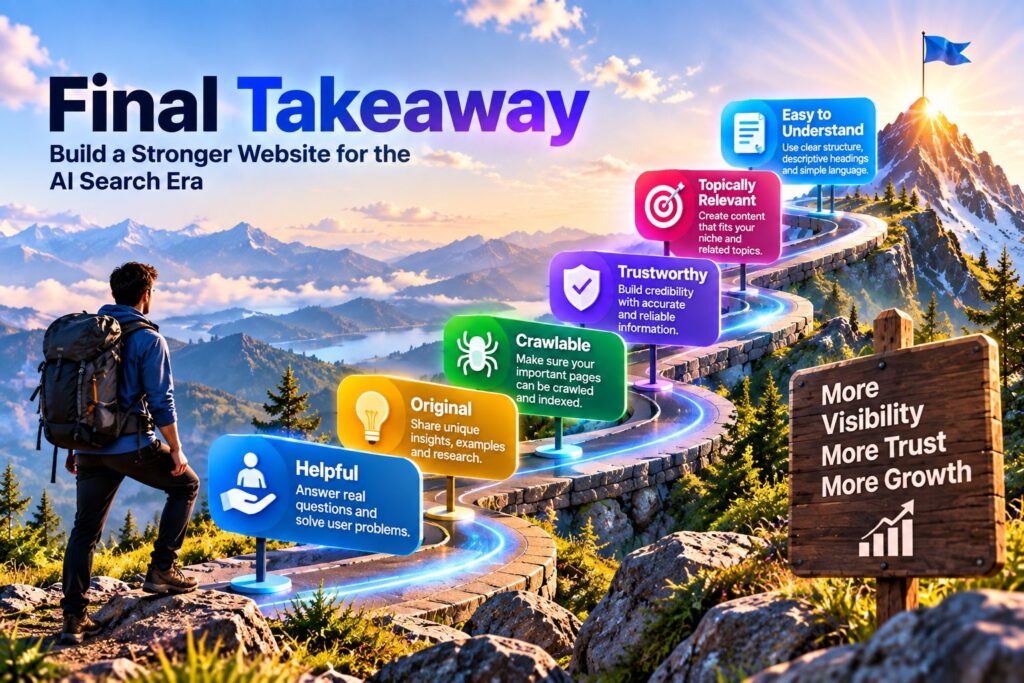
AI search visibility is becoming an important part of modern SEO. But the goal shouldn't be to chase every new AI-search acronym or manufacture content specifically for machines.
Continue investing in traditional SEO.
Create genuinely useful content.
Answer real questions.
Publish original information.
Strengthen your brand across the web.
And measure where your brand appears in AI-generated answers.
The websites that provide genuinely useful information give both people and search systems more reasons to discover, trust, and reference them.